Showing posts with label language. Show all posts

Saturday, October 12, 2013

GeoNarratives

For educators and others: this post is intended as a beginning, a draft for a Gr. 11 student project design. Your feedback is welcome, particularly about communicating these lofty ideas to students so they can understand it, managing steps in the project so they don't get lost, assessment suggestions, and weblinks to examples of similar projects appreciated. I'll also be seeking "critical friends" feedback at Mumbleypeg 2013, an annual meeting of the Pacific Slope Consortium. Virtually all of the students at my school have conducted Heritage Projects or Echo Projects of one flavour or another in Social Studies 9, 10, or 11. This means that they have spent considerable time gathering evidence and stories about past cultures and locations, mainly ones within their own family. For my current group taking Geography 12 and English 11 together in the Language and Landscape Program, I want to provoke them to examine the role that geography played in those stories, and to engage in writing and other creative expression to deconstruct these narratives. We will be assigning a significant number of our learning outcomes to this project, and working through it off and on for about two months.

Enough preamble; here it is:

GeoNarratives: Cross-curricular Project-based Learning about People and Places

Each of us has rich stories in our past, stories that woven together with places. For some, it is the tale of our ancestors as they endured challenges that we can only imagine. For others, the people, places and stories are more immediate, still present within our lives. In all cases there is direct and indirect evidence hiding in language, food, and song, and written into physical and cultural landscapes. 

This project will require building a “geography” and creating a “narrative” -- specifically:
  • heritage inquiry: taking the stories from your personal and cultural background and examining patterns, geographic relationships, and significance -- applying critical geographic thinking to an authentic context 
  • creative non-fiction: writing and creating narratives based on research -- perhaps there is some short cross-over into historical fiction and personal myth-making, but at its heart is the telling of a story that connects to your heritage 
  • embodiment: putting your senses, your artistic side, your physical presence into your research and presentation -- creative expressions of the parts of your research that you find most compelling 
 Aside from the critical thinking and creativity involved, some specific skills will be developed:
  • careful use of technology: placing a digital stamp on this project -- use of an online portfolio, use of technology for research and/or expression, experimenting with something new 
  • literature review and wordtake: surveying the reading and media that relates to your inquiry and using some of it to explore Self and Other, or global issues that impacted your own backstory
This is a broad framework created by your teacher, but it is important that you design the questions that will allow this to be meaningful to you. As your teacher, I can provide as much structure as you think you need to be successful with this project, including narrowing down your topics, suggesting courses of action, and helping you embed “benchmarks of geographic inquiry.” With all this in mind you are free to take this project in new directions, as long as we consider certain learning outcomes that are basic to English Language Arts and Geography, including a high standard for writing.

GeoNarratives at a glance -- considering the impact of geography on the stories from one’s past

The final presentation of your GeoNarrative will take in four parts:
  1. sharing the part of your portfolio that shows your heritage research, literature review, and critical analysis (the conclusions you have made about both the topic and your learning)
  2. sharing some or all of the creative non-fiction (or historical fiction) that you have built around your research 
  3. sharing a performative piece that you made to express or symbolize the deep part of your learning during this project 
  4. use of at least one effective of digital technology in the process of project creation or presentation 
Project Steps (not always in this sequence):
  1. look at and assess example of creative non-fiction, heritage inquiry, and “geographies” 
  2. develop questions and designs for your project 
  3. accumulate primary and secondary evidence and conduct a variety of research 
  4. co-develop aspects of your project and evaluation criteria with student groups and the teacher 
  5. create the pieces that make up your project 
  6. prepare the pieces for sharing, including presentation 
  7. share and present your project 
  8. reflection, celebration, and evaluation 
Examples of stories that would work well as GeoNarratives:
  • immigration experiences, so different depending on location and time period 
  • wartime from civilian or a soldier’s perspective 
  • grandma’s garden, grandpa’s workshop; practicing bygone skills and trades 
  • working on the land; pioneering and homesteading 
  • outdoor lifestyles, a tradition of hunting or fishing 
  • managing a farm and family, homemaking in the past 
Examples of global issues that could be examined within your project:
  • a study of racism/tolerance, language acquisition, or labour market among new immigrants 
  • evolving role and treatment of women in various places, cultures, and time periods 
  • aboriginal ways of knowing and relationship between First Nations and the broader society 
  • the power of wealth: studies of “class” and differences between rich and poor 
  • citizenship, rights and democracy: how much freedom or “agency” did historic groups really have 
  • the idea of sustainability and the relationship that different peoples have with the environment 
  • grief and hope: how did historic groups cope with challenges (could tie in to religious studies) 
Examples of evidence that would support a GeoNarrative:
  • non-fiction, documentaries, history books and websites, academic studies 
  • novels, short stories, works of fiction and poetry from the time period and place that you are examining 
  • artwork or crafts such as paintings, architecture, sketches, sculptures, carvings, jewelry, tools, heirlooms 
  • primary evidence, journals, memoirs, recollections, artifacts, photographs, recipes, travelogues, interviews 
  • genealogical websites, graveyards, government records, family history books 
  • existing “human geography” connected to your topics (studies that parallel your inquiry), historical atlases
Examples of a performative piece:
  • musical creation (e.g. write a song), interpretive dance, historical re-enactment, water colour painting, original poetry, food creation, a model or diorama, puppet show, simulation, class activity, video reflection, narrated slideshow, interactive display, build something
Examples of a digital stamp:
  • use of QR codes to link to key evidence, like a reader’s guide for someone to understand your work 
  • creating an attractive space in your digital portfolio to display some of your work (lots of applications to try for this one) 
  • using video or computer animation for part of your project 
  • conducting interviews via Skype and archiving part of it as portfolio evidence 
  • use of social media for “curating” (assessing and organizing) research or telling/sharing a story
Examples of a projects that put together many strands of inquiry:
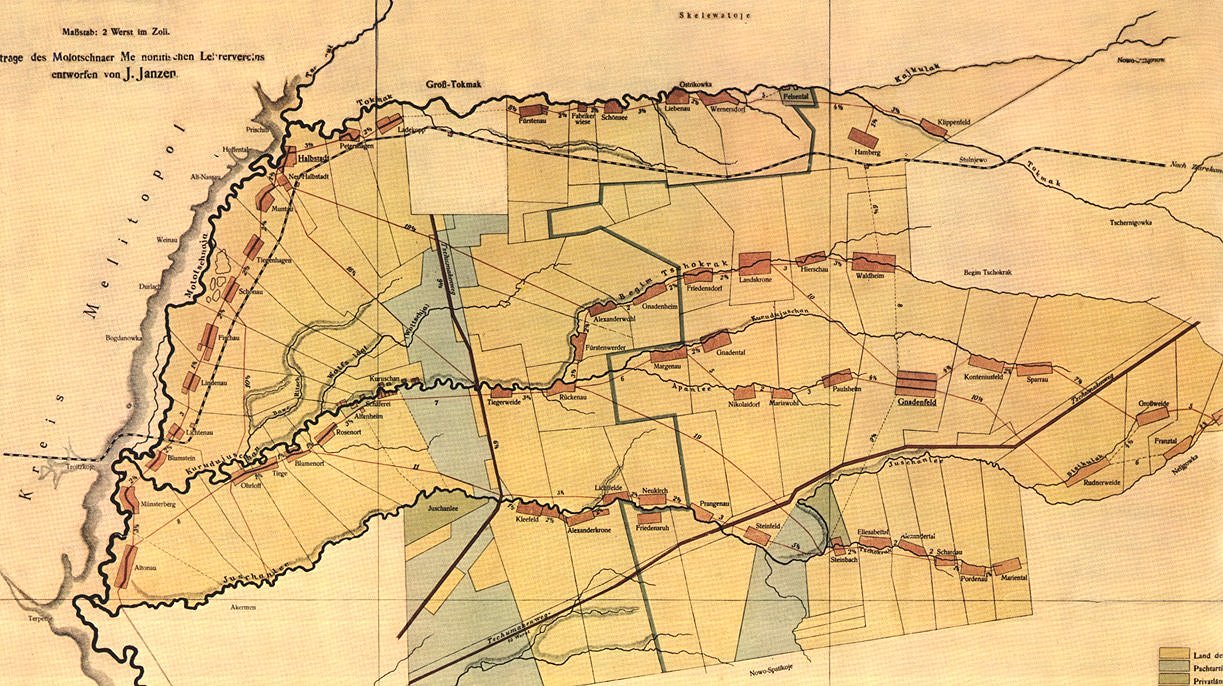
Note on the image at the top: this is a map of the Molotchna colony -- home to Mennonites who left Prussia to settle in this part of South Russia from the 1780s onwards.  After WWI and the Russian Revolution, many of these Mennonites fled to North America, including all four of my grandparents. One of my own GeoNarratives is very much connected to this time, place, and people.

Friday, February 22, 2013

Koyczan and the Pork Chops

Our school has a special memory of Shane Koyczan -- he came to D.P. Todd a couple of years ago in the wake of his performance at the 2010 Olympics opening ceremonies. He was funny, edgy, personable, and provocative. I loved that he gave us a raw outpouring of his art, from the stuff he was experimenting with to the finished work that he has published online. This was a great contrast to the slick productions and "heartstring" speeches we sometimes get for full-school performances. To each their own, but I found Koyczan and his unique slam-prose/poem style delightful because so many students were inspired to keep struggling through their creative writing process, keep struggling through their "being" and place in the school and world. Many students were affirmed in their belief that being different or original was something to celebrate, and that their unique qualities were something to develop, to get better at, not make slave to the ordinary. The personal appeal for me is not so much the style but the honed storytelling and Koyczan's focus on identity... both national/communal and individual/personal. This is a theme, or theme device, that I try to place at the core of curriculum and instructional design in Social Studies.

I am excited to see that Shane Koyczan has made a beautiful new piece called TO THIS DAY PROJECT. I found it difficult to watch -- so much to process, to weigh and judge. I'm not sure yet what I take from it, but it has stuck with me since I watched it last night and I'm thinking about the challenge embedded in the video-poem. Isn't that what at should do?  Great fit as an anti-bullying message and for use in a secondary Planning, Leadership, English, or Social Studies class: http://www.youtube.com/watch?v=ltun92DfnPY


or you can see the video with a bit of context:

http://www.theglobeandmail.com/life/the-hot-button/is-this-the-most-powerful-anti-bullying-message-youve-ever-seen/article8945123/

http://www.theprovince.com/Video+Shane+Koyczan+This/7994081/story.html

I think the discussion questions will arise on their own... feel free to leave a comment about how this video went over with a class.  I'd like to think more about how bullying fits into the larger social justice contexts we wrestle with as teachers.  There are definitely some connections to be made between how kids are treated in school and the culture of narcissism, violence, and porn that lurks on the edge of the student experience at all times.

Another good video I watched recently that challenged my thinking and relates to the anti-bullying and diversity week at our school (Feb. 25 - Mar 1) was "50 Shades of Gay"
http://www.ted.com/talks/io_tillett_wright_fifty_shades_of_gay.html

Tuesday, January 22, 2013

Board Proposal for Middle Earth 12


Presentation (well... highlights, anyways) to accompany proposal for a BC Board/Authority Authorized Course. Middle Earth 12 is a senior Humanities elective course - an authentic, blended approach to the study of language and landscape. Middle Earth 12 is designed to work as a stand-alone course but will be implemented locally within a Humanities Program that also includes other students seeking credit for BC English 11 and Geography 12. Using diverse sources like fantasy fiction, regional environments, and work created or chosen by students, Middle Earth 12 is a Quest for deep connections to people, places and ideas, and powerful skills to interpret and respond to what we discover along the way. Tolkien's creations serve as both a metaphor and model for what we will do in Middle Earth 12 -- he fashioned a personalized landscape using the crafts of a writer, poet, painter, sketch artist, cartographer, medieval scholar, language origin expert, linguistic specialist, environmental devotee, historian, keen observer, and wanderer. He set an example of what relentless curiosity and collaboration can accomplish.

Board/Authority Authorized Course Framework for school trustees and district staff -- "brief" version: http://db.tt/yCrfoQ6A

Documentation on the project development, FAQs, philosophy, and the placement of Middle Earth 12 in the Language and Landscape program at D.P. Todd -- "full" version: http://db.tt/Uziz9EBU

Monday, November 05, 2012

staff mtg course presentation


It's official... time to let my staff know where this is going. What started as a set of ideas about course combination and imaginative content, and became a project in curriculum and learning design is ready for the next level.

This course proposal for D.P. Todd Secondary will see English 11 and Geography 12 combined in a blended learning environment. Students enroll for two blocks of course work, half of it class-room based and half of it outside of class with individual, group,and seminar work. The "blend" refers to both the mix of traditional lessons with flipped or flexible learning, and the mix of in-school with distributed (e.g. online) content and coursework.

We will emphasize self-reliant learning, developing personal learning networks for students, cross-curricular themes, performance-based assessment, interactive technology, social learning, and exploring horizons of significance and authenticity.

In short, a new way for Grade 11 students to complete two courses with compelling curriculum in a two-block program that blends different approaches to teaching and learning.

Space permitting, this program will also allow Grade 12 students to audit parts of the double-course offering and complete a single grad credit board-authorized course: Middle Earth 12.

Comments and feedback welcome. An open planning site for this course can be found at http://dpts.sd57.bc.ca/~gthielmann/middleearth or at http://landspeak.blogspot.com

Sunday, September 16, 2012

Language and Landscape Project


A few months ago, I broached the subject of a "Middle Earth" course at http://thielmann.blogspot.ca/2012/04/middle-earth-11-rough-course-proposal.html.

While I have an educational and teaching background in both English and Geography, it did not occur to me until recently that an interesting combination of these two disciplines would be possible. I think the milieu for curricular experiments has opened up (or come around again), and with support for "project exploration" from students, teachers, and administration, I'd like to offer a course next year at my school (D.P. Todd) that blends BC's English 11 and Geography 12 and takes place in two blocks during one semester.  The course will address all corresponding PLOs and a "hook" to the course will involve literary and geographical examples drawn from Tolkien's Middle Earth, albeit as a point of departure rather than a destination.

A special dimension to this course offering is the blended learning delivery model.  One of the two blocks for which the students sign up will look much like a traditional classroom with expectations for regular attendance, direct instruction from the teacher, and so on.  The second block will be "flipped" -- this is project-based learning time, tutorial, independent work, seminar and small group sessions for the teacher and students.  In designing a course this way I am attempting to respond, interpret, and interrogate the BCEd Plan and "personalized learning" in a way that makes sense to me, our students, and our school.  At a practical level, it allows students create some personal designs around their own learning without losing the guidance offered from a well-planned program of study and a committed teacher they interact with daily.

I would like to involve others with some of the early planning and feedback, as this course offering will affect the 2013-2014 teaching timetable for our school and will not look the same as a regular course. I would like to see the work my students and I do as part of the continuum of language, literacy, and communication goals that are common within the English and Social Studies department at my school.

The course will be a "program" in the sense of how our "Socials 90 program" at D.P. Todd combines two courses and requires some special commitments. This project is tentatively titled Language & Landscape 11. As a new offering, it may simply be a double-registration in English 11 and Geography 12, although we are open to this being a pilot program and containing a unique stand-alone Gr. 12 credit (board-authorized). Sorting this out is part of the "project exploration" to ensure access, quality, and funding consistent with other courses and programs.

For more detailed information, please follow the project as it develops at http://dpts.sd57.bc.ca/~gthielmann/LL11. I've attempted to anticipate and address a range of inquiries that are likely to be on the minds of stakeholders in a project like this.

If you are interested, please let me know what you think in person, by email, twitter, or a comment below, preferably some time in the next month. I covet your feedback and opportunities to collaborate on this project. Specifically, I would appreciate links and suggestions for blended delivery, crossovers lesson topics between English/Language Arts and Geography/Environmental education, and PBL ideas that make sense in the tradition of Middle Earth studies and both academic disciplines. I've got my own ideas on to make a go of this, but I also know that others would like to contribute. General comments, warnings, laughs, and questions are welcome too!