Showing posts with label PBL. Show all posts

Wednesday, April 30, 2014

PBL slow steady progress

I have had the pleasure of taking in some wonderful student presentations in my Middle Earth 12 class over the last week.  It took considerable time for the students to work through essential questions and other stages of project-based learning (PBL) development. It is not clear to me that PBL is as "productive" as other forms of learning -- and yet I am impressed with how the early projects represent learner identity and authentic research. I am increasingly convinced that with an unsorted group of students (e.g. an average crowd in a public school classroom), PBL must be blended with more traditional forms of learning. The all-or-nothing PBL approach requires resources I do not possess, structures that are unrealistic, and technology that is not accessible. In fact, I think PBL will be most successful in contexts where it is necessary to break down curricular walls. Nonetheless, we are making slow, steady progress towards both our course goals and a thorough examination of PBL.  Here are the first three presentations:
  • Can the use of creative writing and visual arts be used to understand and empathize with daily life in a medieval village?
This turned into an interesting construction of a fictional medieval village in two ways -- writing which explored the evolution of social structures in Britain leading up to feudalism, and a model of the village built out kits that the students crafted from a variety of internet "maker" sources.  I learned some new things from the students' timeline about the evolution of British society and was impressed with the amount of time it took to build the village.  Both presenters had knowledge about their topics that exceeded what they presented... in other words, there was a depth of understanding that formed a foundation for their project, rather than "just-in-time" learning that scratched the surface.
  • What patterns are in place in the lore and creation of Dark Souls characters such as Havel the Rock?
This student project focused on character development and speculated as to what the game writers had in mind when they created various "NPCs" in Dark Souls.  The discussion extended into archetypes, base qualities and symbolism behind the characters, with comparisons to Greek mythology and Tolkien's creations.  The presenter is a hardcore gamer, but this did not prevent him from being overly technical during his narration of video clips.
  • How and why have monsters such as werewolves developed in modern literature and cinema?
The project grew to become a study of the Trio of Gothic Monsters (Werewolf, Vampire, Frankenstein), their literary origins and cinematic debuts, and the role they played in popular culture a century ago compared to today. The student's conclusion was that the roles were similar, but not the same: in the past, these monsters were scapegoats, a way to blame society's ills on external forces, whereas in the present these monsters are used as a release for our tensions and way to address our anxieties, particularly about growing up. The student was definitely "caught" by her own research, and was busy reading Shelly's Frankenstein before and after her presentation.  We got to hear quotes from the Romantics, video clips from 30s and 40s films, and insightful analysis from the student who drew from a deep well in her presentation to the class

Tuesday, February 04, 2014

Tapestry Workshops

Hello Victoria, Sooke, Sanich and Gulf Islands Teachers!


The organizers for the Tapestry Conference tell me that my workshops need some more souls or they might have to cancel. I'm really hoping to make the trip down there (from Prince George) for your Feb 21 Conference, so if you can help recommend a few people (or yourself) to attend one or both of these sessions I would be very grateful.  Tapestry Registration here.


Morning Session:

Heritage Inquiry: Connecting Land, People, and Narrative

Target audience: Secondary Humanities especially Social Studies, History, Geography, and English

Project-based learning using heritage research as the basis of cross-curricular inquiry and application of critical thinking skills. Case studies from Social Studies 10 and 11, Geography 12, and suggestions for adapting this work to other contexts. These projects have grabbed students and provided relevance, a basis for empathy, and really great presentations. You'll be amazed at the artifacts that students find in their basements.  Examples of Heritage projects.


Afternoon Session:

When Educators Co-create: Experimental Course Design for Secondary Schools

Target audience: Secondary teachers

Listen to some ideas from a Northern BC Professional Learning Network about course combinations, blended learning, simulations, and cross-curricular projects, including Middle Earth 12 and the Language and Landscape program (combination of English 11 and Geography 12).  Other courses and combinations we've tried or are trying "up here" include Yoga, Peer Mentorship, History of Social Justice Through Music, Geography combined with Digital Media Arts, History combined with "Cultures in Conflict" (another local course), and Genocide.

Then, the conversation can move to match the audience:
  • engage in a “critical friends” activity that will tune your own curriculum/instruction ideas or designs for project-based learning
  • look at what it takes to build your own locally developed course or adapt an existing one to new curriculum structures, including Board approval process and incorporating team teaching
  • discuss how blended learning (mix of in-class, online, and community-based settings) can be used with new and existing courses, including use of digital portfolios

So.... sign up for one or both, and bring a friend with you!

Cheers,
Glen Thielmann


Friday, January 24, 2014

GeoNarrative Paula

This year's cohort in the "Language and Landscape Program" recently presented their GeoNarratives -- a historical/geographical study of a specific place, time, person/s, and/or event.  This "project-based learning" was meant to roll many English 11 and Geography 12 learning outcomes together for our blended learning, course combination approach.  The students had time in and out of class over a few months to put this together.

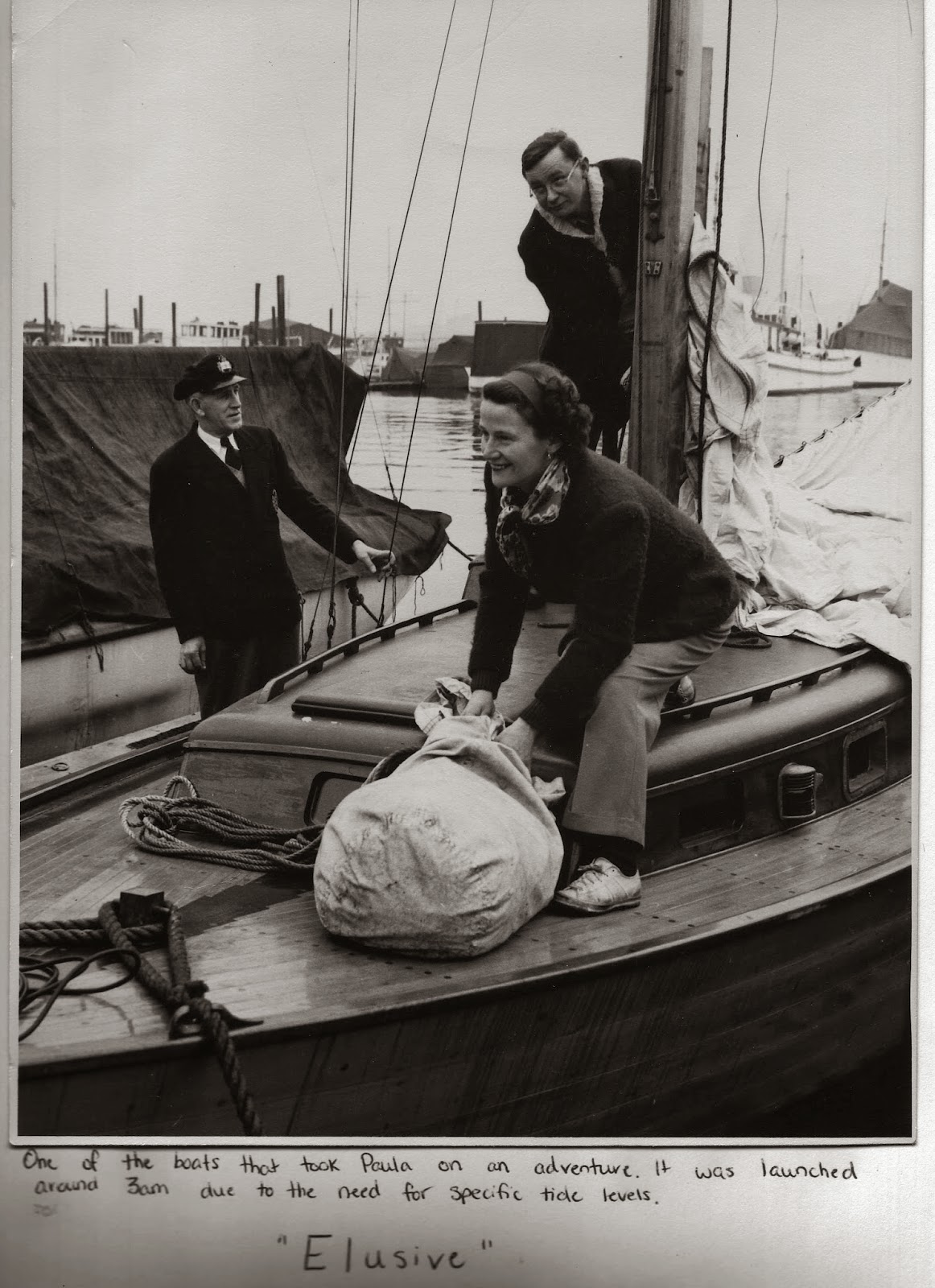
One of my students "P.C." built her project and presentation around what life was like for a woman coming of age in the 1930s and living a life of some privilege in the Vancouver of the 1940s-1960s.  The focus was her great-aunt Paula, a larger-than-life personality in the personal narrative of P.C.'s family who, with her husband, travelled extensively and left an impression on those around them.  Paula. among other things, was one of the first women to join the Vancouver Yacht Club, and was a careful recorder of life around her.

P.C.'s project involved designing inquiry, conducting personal research, curating evidence from a variety of sources (mainly primary documents), building a scrapbook to summarize her inquiry, and writing a short story from the perspective of Paula on he honeymoon. P.C.'s narrative for us (her audience) tried to capture both the extraordinary qualities of Paula, but also the more general characteristics of a time and place (Vancouver, 1930-1960).  Alongside this "evolving landscape" were descriptions of the many clubs, theatres, and restaurants that Paula visited.

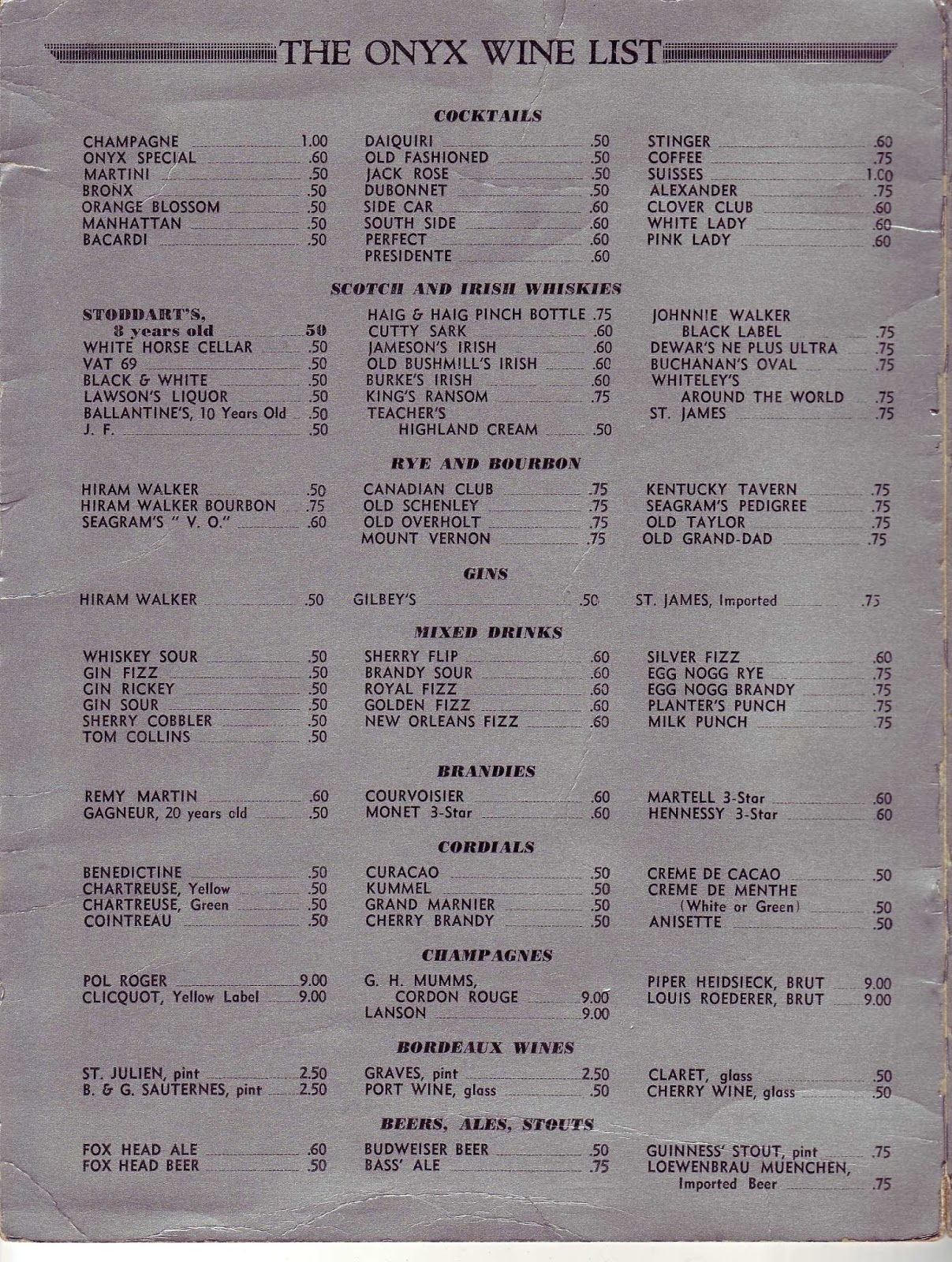
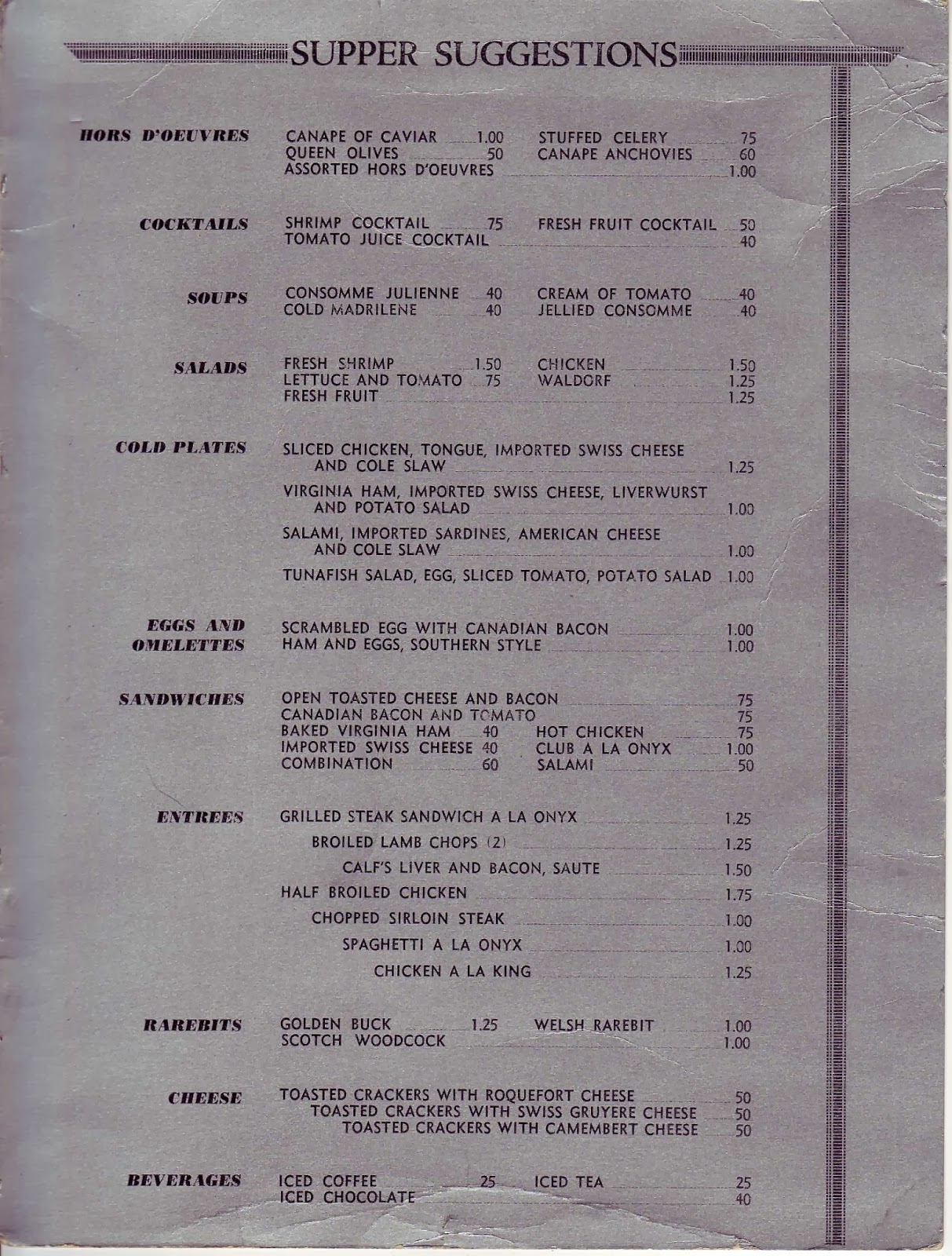
One of the many artifacts that P.C. used to structure her presentation were the menus from some of these restaurants, saved by Paula as mementos and kept in the family after her passing.  I found this one intriguing, love the inclusion of cow's tongue and rarebits: