 |
| A stand of Doug-firs on the northwest corner of UNBC Prince George campus, seen here in February 2020. Most important things in my life have happened near or under a Douglas Fir tree – Pseudotsuga menziesii – or a Doug-fir as many of us call it. This present adventure – a change in job and a return to school as a student – is no exception, and is reinforced now by the view from my office at the University of Northern British Columbia on a September morning out to a second-growth stand of Doug-firs, the smallest movement there hinting at a breeze, a breath in the forest. Walking there, at the edge I can see I am entering a managed ecosystem; some stems have been thinned and the woody debris cleared away, and evidence of a logging history and crisscross of humans and their litter is written on the ground. It is perhaps too close to campus to be called wild, but just a few metres into the stand, the sounds of the university recede and older sounds come through the firs and the willow shrubs. Here, the stand is looking more familiar, with bunchberries and wintergreen and pipsissewa poking through the red featherstem moss that carpets the forest floor. Here, a mushroom brings word of the underground network of fungal mycelium, threads that connect root to root, cycle nutrients and biochemical advice from tree to tree. The mycelial network is likely thriving after whatever setback it faced when this stand was first logged – the trees are sharing secrets in the soil (Wohlleben, 2015). Some of the earliest work that established how trees talk to each other through mycorrhizal associations was done amongst Doug-firs (Toomey, 2016); they have been since, perhaps always, sharing some of their secrets with humans who have been willing to listen. Knowing this for some time, when I walk here, I am aware that a community is at work, sending signals about kin, climate, and food from fir to fir. From a lifelong fascination with maps, stories, and local geography, I begin to see this as a landscape. In the etymological sense, a landscape is a construct, a land-based representation or portrayal – the ship part (OE scype) refers to an appointment, ordination, or creation (as in a fellowship) rather than a ship (OE scipian) that sails on the seas (Little, et al, 1955, pp. 1874–1875). A ship – an appointment, ordination, or creation. What is being represented here? What layers in the physical and cultural landscape are seen and heard now, and what layers are hidden in this portrayal? What stories are held in place by the humus, stored in the submesic soil in wait for a telling, or being told right now in language I cannot understand? Here, the sightlines of academia are still present, with the sound of a building’s HVAC system coming through the trees like water over rocks, and here is evidence of recent silviculture and what appears to be the remnants of a bike jump; but not long gone are signs of industrial forestry and previous land uses. Here, perhaps, was a hunting trail or berry patch visited by the Lheidli Tenneh; maybe they will be here again when the berries come back. Here, I walk on moss and fir needles. Below the litter is podzolic soil, and deeper still, glacial till, sculpted into spoon-shaped drumlins by the slow violence of ancient ice, and then softened by cold waves in a glacial lake 10,000 years ago. These layers have contributed to the identity of people, place, and land on this campus, this community, this region. These stories, happening many times, are how places are formed (Stafford, 1987), and are all part of what surfaces when the geographer in me asks “what is where, why there, and why care?” (Gritzner, 2002). But at this moment, this geographer’s mind almost misses what the Doug-firs are asking of me, carried up from the great fungal threads in the podzol and shipped through the understory by the smell of earth on the small breeze: “what appointment are you seeking here, to what work are you ordained, and what do you hope to create?” This possibility of place, this question from the landscape itself -- a call to ordination from the firs -- is at the root my research. It is also a question that new teachers encounter as they begin their work with students and sort out the kind of pedagogy they wish to establish and what value they hope to find in it. In turn, their students ask similar questions, a wandering about through educational landscapes in search of a path, in search of a horizon. For many educators, a teaching practice that is drawn to place as site and source of learning is an intentional act to engage the questions of their landscapes, to situate and establish their own identity as people who are called to teach, create, and make sense of the paths they walk and the “horizons of significance” they envision (Taylor, 1991), to know who they are in this space. My own path here, to the Natural Resources and Environmental Studies (NRES) PhD program at the UNBC, began in September 2019 after a 23-year career in K-12 public education as a Social Studies teacher. The first year in this interdisciplinary program featured coursework on the philosophy of science, frameworks and critical considerations for conducting and communication research, and interdisciplinarity. Since the 2004 completion of my Master’s degree in Education from Simon Fraser University and throughout my teaching career, I have been interested in research into Geography education in K-12 schools, decolonizing schools and pedagogy, place-responsive teaching and learning, and the role of student and teacher storytelling in Social Studies. This interest has been expressed in my teaching, most notably in student inquiry projects that explored self and the world in the context of history, geography, heritage, and culture. That was not always the work that I was appointed and paid to do, but it was certainly the work for which I was ordained by the path I followed. I have used the first year of the doctoral program and employment in UNBC’s teacher education program to synthesize these research ideas and develop a new pathway towards expanded horizons of significance for myself and other place-responsive educators who seek authenticity, to be "people who are perceived as 'authoring' their own words, their own actions, their own lives, rather than playing a scripted role at great remove from their own hearts" (Palmer, 2007, p. 117). References: Gritzner, C. F. (2002). What is where, why there, and why care? Journal of Geography, 101(1), 38–40. Little, W., Fowler, H. W., & Coulson, J. (1955). The Oxford universal dictionary on historical principles(3rd ed.; C. T. Onions, Ed.). London, UK: Oxford University Press. Palmer, P. J. (2007). The courage to teach guide for reflection and renewal. Hoboken, NJ: John Wiley & Sons. Stafford, K. (1987). There are no names but stories. In Places and stories. Pittsburgh: Carnegie Mellon University Press. Taylor, C. (1991). The malaise of modernity. Concord, ON: House of Anansi Press. Toomey, D. (2016). Exploring how and why trees ‘talk’ to each other. Retrieved October 1, 2020, from Yale Environment 260 website: https://e360.yale.edu/features/exploring_how_and_why_trees_talk_to_each_other Wohlleben, P. (2015). The hidden life of trees: What they feel, how they communicate - discoveries from a secret world. Vancouver, BC: Greystone Books. |
Showing posts with label place-based learning. Show all posts
Showing posts with label place-based learning. Show all posts
Wednesday, October 21, 2020
Ordination of Firs

Friday, January 24, 2014
GeoNarrative Paula
This year's cohort in the "Language and Landscape Program" recently presented their GeoNarratives -- a historical/geographical study of a specific place, time, person/s, and/or event. This "project-based learning" was meant to roll many English 11 and Geography 12 learning outcomes together for our blended learning, course combination approach. The students had time in and out of class over a few months to put this together.
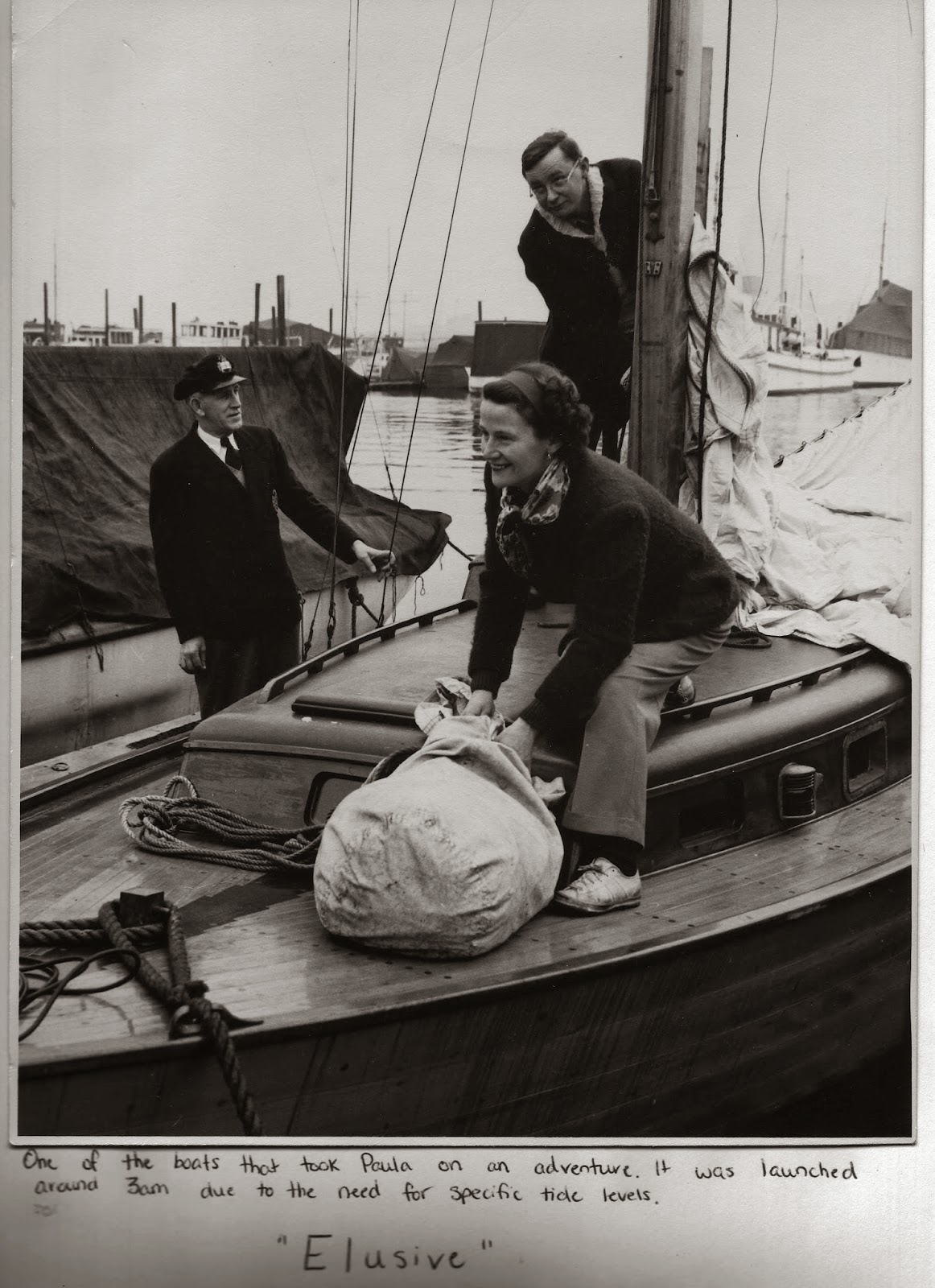
One of my students "P.C." built her project and presentation around what life was like for a woman coming of age in the 1930s and living a life of some privilege in the Vancouver of the 1940s-1960s. The focus was her great-aunt Paula, a larger-than-life personality in the personal narrative of P.C.'s family who, with her husband, travelled extensively and left an impression on those around them. Paula. among other things, was one of the first women to join the Vancouver Yacht Club, and was a careful recorder of life around her.
P.C.'s project involved designing inquiry, conducting personal research, curating evidence from a variety of sources (mainly primary documents), building a scrapbook to summarize her inquiry, and writing a short story from the perspective of Paula on he honeymoon. P.C.'s narrative for us (her audience) tried to capture both the extraordinary qualities of Paula, but also the more general characteristics of a time and place (Vancouver, 1930-1960). Alongside this "evolving landscape" were descriptions of the many clubs, theatres, and restaurants that Paula visited.
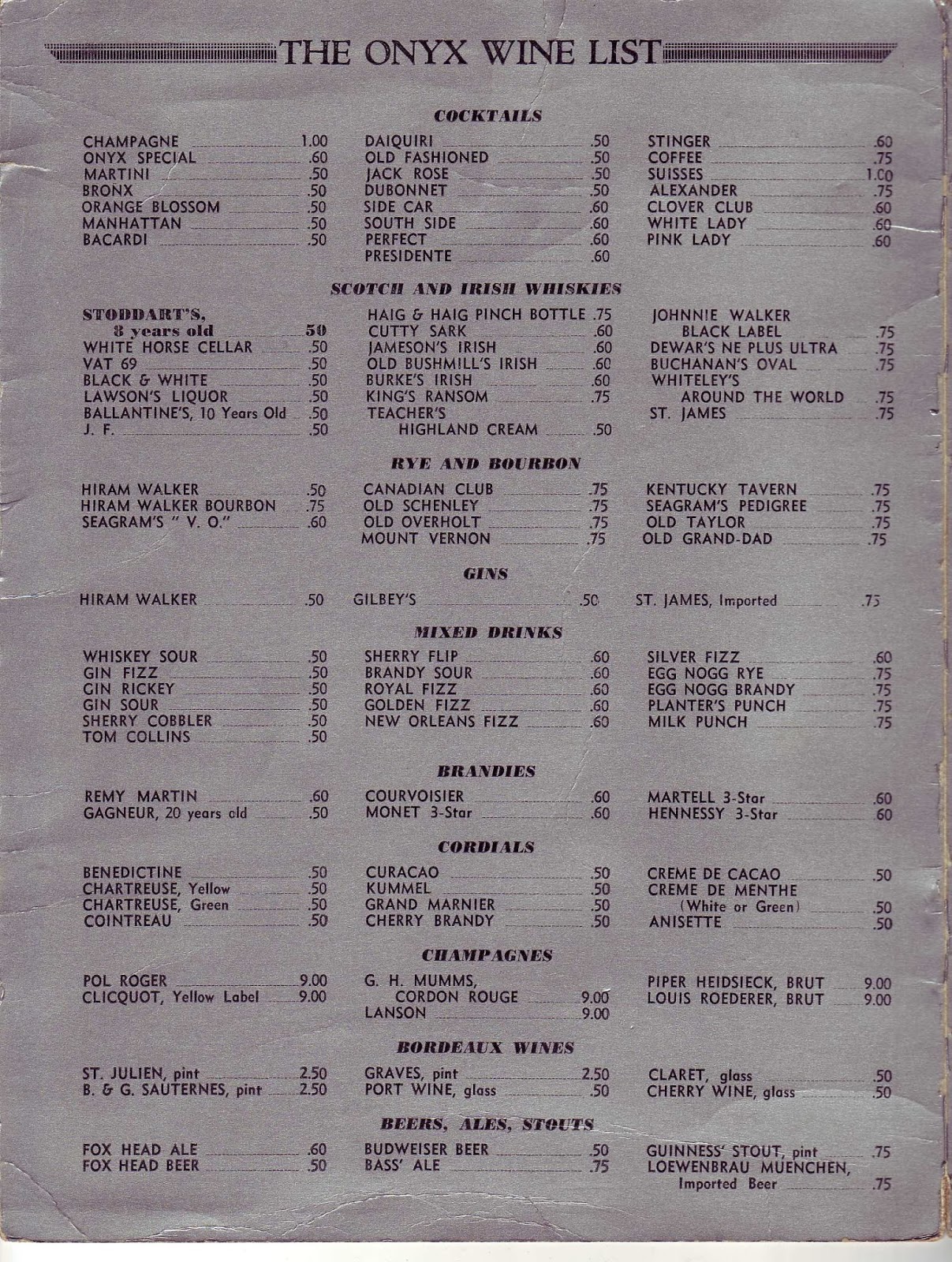
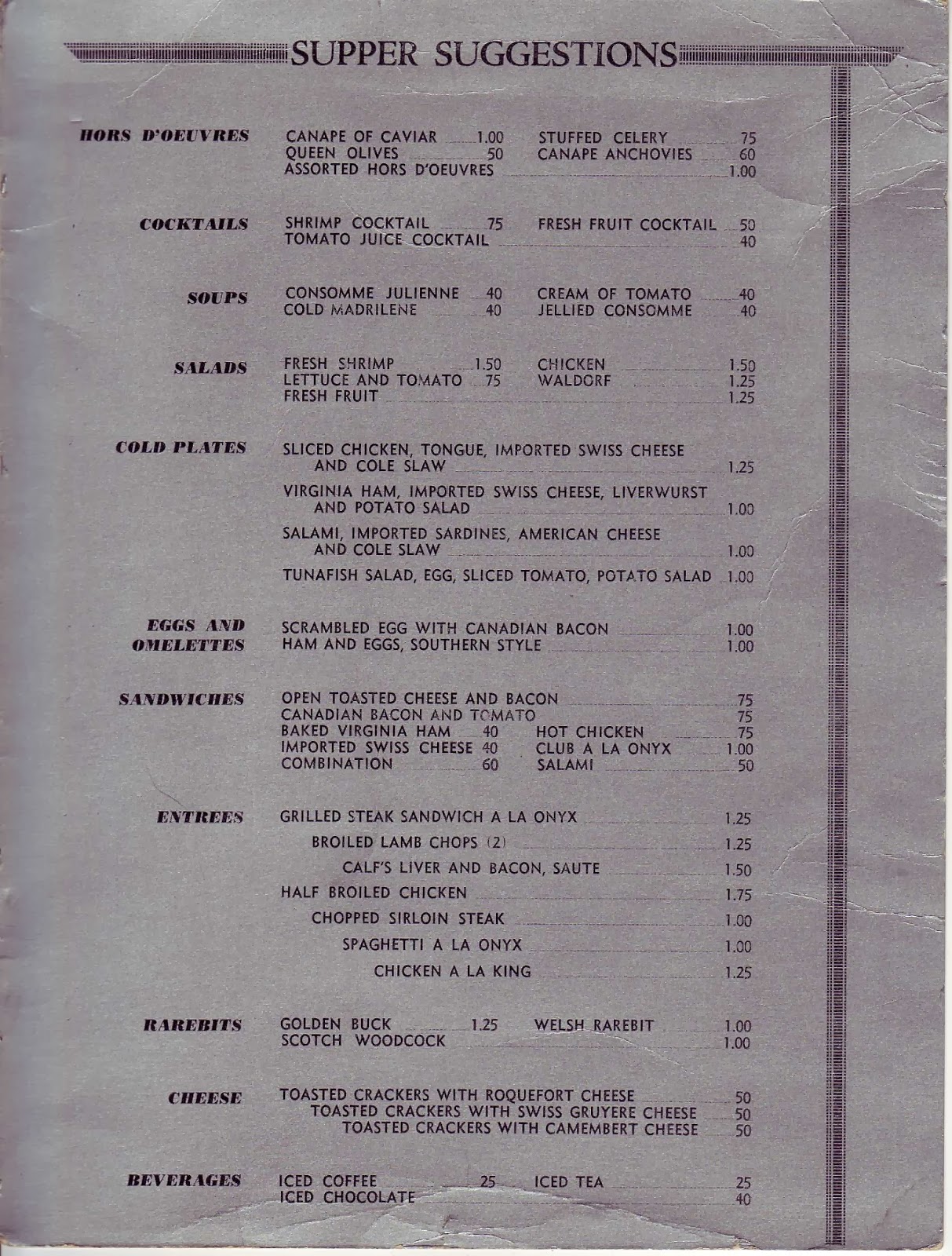
One of the many artifacts that P.C. used to structure her presentation were the menus from some of these restaurants, saved by Paula as mementos and kept in the family after her passing. I found this one intriguing, love the inclusion of cow's tongue and rarebits:


Wednesday, October 30, 2013
Ancient Forest


1. What is the nature of this place? What themes or thoughts or actions make sense in this place?
- Traditional Ecological Knowledge - the cedars are foundational to Aboriginal culture in BC (building material, ceremonial purposes etc.); the dominant understory shrub here is Devil's Club (Oplopanax horribilis), also an important plant for First Peoples, primarily for powerful medicine as I understand it. There is a lot of potential for both the study and, with some respectful protocol, the practice of ethobotany. We saw wild ginger on our walk (delicacy), but we also saw a highly poisonous hellabore.
- Ecosystem Relationships - as mentioned above this place is unique and it is possible to see variety of biogeoclimatic processes at work. For example, understanding soil moisture on this slope position anf within the local subclimate is key to understanding why these forests contain giant redcedars instead of the usual spruce, pine, and fir. This forest offers many opportunities to examine the nurtrient cycle and the stages of forest renewal. Beneath the rootwheels thrown up by trees blown over in winter storms there are natural soil pits that allowed us to see and touch the "till" (parent material) and clay loam (surface soil). We also happened across Dave King, a famous hiker and trail-maker in our region who was repairing a section of board walk. He gave our group short talk and lent me his shovel and pulaski so I could did a little soil pit to show why these soils were part of the reason why the redcedars thrived. Digging through the first bit of humus was the opening to talk about biodiversity. Boreal and sub-boreal forests (like this rainforest) owe much of their vitality to biological action in the soil, whereas in tropical rainforests most of the action is in the canopy.
2. How much can or should I wrangle students; is it important for me to convey what I find valuable about this forest?
- In the end, I think it is important to throw out some "teacher wisdom" when the scene is right, but there is only so much control that can be expected when you have teens running around in a forest.
- Maybe the key is to have a few places to stop with something specific in mind, rather than trying to create running commentary. This feels much more like being "present" which in the case of the Ancient Forest is not hard. Lots of "presence" in there to attend to.
3. What does nature/place-based learning look like? What can we learn about ourselves from this specific place?
- For me this came down to senses. The sweet forest debris, the wash of scented needles born down on the mist, the noise of water (trickles here and there, a substantial waterfall at the top), the sounds of twigs breaking and students calling out and laughing. There was a warm and cool about the day, a chance to get dirt on one's hands and to feel something sharp in the form of a rock or branch stub. This simply does not happen in a classroom.
- I tried to do two things to get students out of their urban armour. First, I led about half of them off the path into some blowdown and brush -- by led I mean I simply ran off towards a fallen tree and half of them followed me. Second, I egged almost all of them to climb up to the base of Treebeard Falls and play around in the rocks and water for a while. In the closed-in space (rock walls on three sides, clothed in moss and ferns, glittering stones about our feet), I asked them to close their eyes and listen for 30 seconds, just breath and listen. I have no idea what they got out of that but I sense it was a little magic moment. I felt that way, anyways.
- Some students stuck in a big pack, others wandered around in 2s or 3s, and some were anxious to move on (e.g. pitstops to talk about lichens did not appeal) or did not want to catch up (having fund taking photos or looking at stuff). Learning in nature takes on intense differentiation -- I'm realizing that unusual settings can amplify the identity-rich markers that are often difficult to see when the kids are stuck in the melting pot of a high school. For example, it was easier to see who was a leader, who was a helper, who needed affirmation, who wanted to share stories, and who wanted to experience the perceived learning intentions on their own terms. This concept was pointed out to me many times by an early mentor, Norm Booth -- we never really know what students learn. We assess student output using our up-to-date tools, and they sometimes tell us what they've learned, but the actual stuff that takes place in their brains is not easily defined; it is abstract and profound, perhaps even sacred.
4. What should I do next time, next semester when I take a group of Grade 12s out here?
- I think a bit more pre-reading is in order, so that the forest denizens (the trees, the devil's club, the valley itself) have more a of backstory for the students.
- I loved that we brought sandwich fixings and made our own lunch. Repeat that.
Thanks to my student DB for the pics... here's three more:


Subscribe to:
Posts (Atom)