Friday, November 25, 2011

Red Fife

I was giving a lesson yesterday on the big immigration drives during Laurier's time as prime minister (1896-1911) and the work of his minister Clifford Sifton.  My lesson was all over the place, I talked about the CPR and what John A. Macdonald had in mind. I had maps and digital images of "last best west" posters on the go, textbook stuff, a short video clip, asked students to relate the immigration stories they were digging up in the computer lab with their heritage research, etc. We talked about dryland farming, boat rides, sod houses and various people's ancestors (including mine). We found a few of "our people came over" as a result of Sifton's campaigns. I had an recent news story lined up for a current events connection but the streaming video wasn't working on the browser; luckily a student new what I was trying to find (Canadian gov't decision on uniting families of immigrants) and read out another version of the story he found on his iphone. I wanted to introduce them to the concept of critical inquiry benchmarks, thought this was the day to do it, but didn't remember to do it (although I suppose we practiced about 5 of them). Typical chaotic Thielmann lesson, a little bit of everything... yes, some "21C" but lots of 20th Century stand-and-deliver and even "random century" stuff thrown in for good measure (shared story-telling). It bugs me that our educational leaders try to create a divide based on technology where it does not really exist. This lesson is essentially the same as one my father might have given 40 years ago.

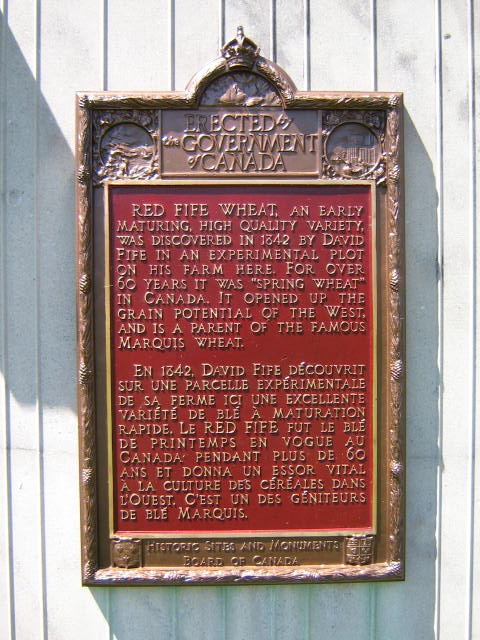
Anyways, I made a brief reference to red fife, the wheat that fed Canada until about 1904, and a student chimed in that her family had found a bag of red fife stored in a grandmother's attic. This is interesting, because the original red fife all but disappeared when it fell out of favour in the early 1900s (replaced in large part by Marquis wheat), although it was bred with other varieties to become the "grandfather" to other important wheats. A few farmers have kept the grains, fewer still have kept it growing in small plots, and apparently it has made a bit of a comeback as an heirloom grain with good nutrient and protein characteristics, as a landrace it has an honourable spot in the discussion about genetic diversity and ecological resilience. I imagine few students, especially KT, can envision their great-great-grandparents picking up a bag of red fife grains from caring neighbours at the turn of the 20th century, to begin their Canadian Prairie odyssey. Afterwards, I read through my own "family book" today and realized that this was the same variety of wheat that my great-great-grandfather Jacob Loewen broadcast seeded on his new 160-acre homestead in Dalmeny, Saskatchewan, 1902. I think the students "got it" when I tried to explain that even something like food can have a impact on the social and economic development of a nation. Of course we all asked KT "what did you do with the wheat?!" ..."we threw it out -- it had mouse poop in it."

Monday, November 21, 2011

open letter to trustees re new choice program

Dear trustees,

First of all, I notice this is your final meeting in the current composition, and I would like to thank you for your most recent three years of service to public education. You’ve been very busy with important work set in front of you, and the new board will probably face new challenges you did not but may also be able to avoid the incredibly difficult process of school closure and cutbacks. Good luck to those moving on to new opportunities.

Second, I notice that a choice program proposal for KRSS Northern Learning Centre is on the agenda for the Nov 22 board meeting. The proposal hits on all of the keywords of the new government plan, and will no doubt test the appetite for "21st Century Learning" among staff, students, and parents. It will also test some contract expectations related to distributed learning ratios, instructional time, school-based supervision responsibilities, etc. At this stage the proposal seems to be at the idea level and does not yet appear to be a teacher-driven program, as there are many teachers at KRSS that are unaware of this initiative, and have not been involved in the program planning. I realize, however, that staff-admin consultation is difficult during the current job action.

The proposal does have positive potential, though, and I believe the board should use the discussion of this program proposal as an opportunity to thaw some of the disconnect between teacher & student innovation with technology-embedded learning and a restrictive set of practices from the board office on similar projects elsewhere. Teacher buy-in, particularly by technology leaders, is required for success as they will do the heavy lifting for this program and have felt ignored and excluded by the school district on a range of technology issues over the last eight years. The last 3-5 years in particular has seen what has been referred to as a "chilly climate for 21st century learning" in our school district. There has been lots of talk about innovation and change, but the reality is that virtually every process for educators and district staff to align goals, leverage innovation, and dialogue about program development has been cut off (DTT, KTC, TFL, Tech Coach groups, Teacher Tech leadership positions, TLITE follow-up initiatives, workshop training program, etc.). In their place are a few learning team grants that allow schools to use release time for group study but do not affect district-wide approaches other than what teachers initiate themselves. The details of this “chilly climate” have been thoroughly documented in the feedback given to last April's "Enhancing Learning" presentation by board office staff - this multi-school contribution has been archived if you have not read it. The feedback from the PGSS tech team is an excellent place to start. Perhaps as the capacity for a district-wide collaborative approach to understanding technology for learning has diminished or been cut back, the ability to recognize "21st century learning" where it is thriving has also suffered. Six or more "21st century learning" projects proposed by teachers and administration in the last two years have been rejected by the board office, most of which have never received even an explanation of who did the rejecting, let alone an invitation to discuss why these innovative projects were dismissed. When passionate, talented educators volunteer to move the district's learning agenda forward, I cannot fathom why the default response has been "no.” Again, this irony, and the many restrictions encountered by teachers as they seek to understand how “21st century learning” notions might work for their students are well documented in the “Enhancing Learning” feedback. The proposed KRSS program looks like a proposal submitted at D.P. Todd two years ago (rejected) and also like one of the key recommendations from the QLG group in 2004. The QLG was a district- supported teacher & admin group that researched blended, distributed, personalized, and online education models. They suggested that all secondary schools encourage and be supported for pilots that combined dynamic teacher and student-group time with online learning and project-based learning. The QLG recommendations related to wide school-based online learning pilots were not well accepted by the board office admin and the mandate for developing online learning was instead given to CLA. While the CLA has done many excellent things in the interim, the focus on blended learning has not been a priority. Seven years later perhaps the board office is ready for a second look at these ideas with this KRSS proposal on the agenda. I am pleased that the focus for blended learning is going back out to schools as was suggested in 2004 -- this will help the board office walk its talk on educational change.

The proposal does raise many issues, however, the first of which might be jumping the gun on “21st century learning” prior to the ministry creating an overall plan and guiding framework, review of curriculum, etc. that were outlined in the new direction from the ministry. Aside from the reliance on vague keywords, the apparent lack of teacher buy-in (again, difficult during job action), and potential contract issues, the program does have merits that justify consideration if certain questions are answered. I would like to see a program like this work as I and others have proposed similar projects in the past, but we all need the foundation laid out and tough questions asked before this program is approved and before teachers can be asked to sign on. Getting this right could help warm up the chilly climate in SD57 for collaboration between the board office, admin, and teachers. Failing to do so will result in more misunderstanding and withdrawal from tech leaders and innovative teachers at KRSS and elsewhere.

As you review the proposal, I would suggest you start by asking a few questions:
  1. How can teachers be better involved in the program planning and development? 
  2. How will KRSS engage existing expertise in our district and UNBC regarding blended and/or distributed learning and independent project-based environments? 
  3. Does the lateral growth described in 2.3.1.a) signify that other schools will be encouraged and supported to build similar programs? 
  4. Does the program's existence mean that the board office is now willing to consider the kind of blended learning and 21st century learning projects it has rejected over the last two years? 
  5. Will program support and review benefit by the restoration of some (any) district-level tables for discussion of common issues and aspirations regarding technology and learning? 
  6. Does the program prejudice any contractual considerations re class size ratios, hours of instruction, hiring, and so on? 
  7. The proposal states that schools and teachers are performing for students rather than working with them. What does this mean? 
  8. Is there any accepted research backing the claims made about Grade 8/9 students being qualified to design their own learning plans and work with minimal supervision? 
  9. Are digital devices affordable by all students and do they really replace the need for staffed libraries? 
  10. How will the program address supervision of students when students are working independently, at home, or "out in the community?"

Tuesday, November 15, 2011

Weathered Stone

As my students continue to make fabulous connections to their heritage and ask questions about what defines oneself, I find myself drifting back to the hobbyist genealogy work I began a few years ago. One of the links I found for my students (see the Heritage Research Tools on the right bar of the Webriver Blog) introduced me to some new names in my wife's family tree, and some interesting sites on cemetery archiving. Genealogists talk about hitting a brick wall, and how excited they get when it comes down and there is new territory to explore. My students have described this, too, in the last couple of weeks, the experience of staying up all night to find one more story, names, event, or connection online or in an old book rediscovered. Finding out about stuff that was "there" but hidden from them for a variety of reasons, mostly that their curiousity was never trained on the subject.

The students have been telling me their stories, so I told one of mine... here's a part of what I shared in class today, using good old-fashioned story-telling, Google Earth, a couple of websites, and a pull down map. My "treasure" was found at about 1 a.m. as I trained my own curiosity on some of the missing links in my wife's family tree. It seems a researcher visited a Cape Breton cemetery, wandered over to the adjacent woods, and found an old gate leading to more gravestones midst the brush and trees. One of the stones he found marked the grave of my wife's great-great-grandfather in Point Edward Nova Scotia (pic shown above). The only other info I had for him was that he was lost at sea, so now I have two stories to reconcile, and some excitement about the evidence. I'll have to visit there one day to see for myself and look around for the stones of two others whose names are listed as being there. The street view on Google Earth, which includes the old church and cemetery helped me visualize what was going on and speculate about the cultural, economic, and geographical adaptations that had been made in this area of Nova Scotia. Like my students, I find my thoughts drifting back to images, maps, stories, historical contexts, concurrent events, and evolving landscapes... not a bad way to spend time in a Social Studies class.

Saturday, November 12, 2011

kudos for staff websites

There are so many great ways, ancient and new, that we all conduct our teaching practices. I'd like to thank and encourage the teachers who have built new webpages this year or continue to develop their existing websites. Some of you are also blogging, tweeting, and using social media and other digital tools to affect learning (yours and your students). Your work has modeled a thoughtful web presence for students, administration, parents, etc., and shows both the collective commitment to student success and the diversity of teacher interests or approaches to learning. Sometimes it is easy to think that your website or digital activity is mainly for yourself. That's not a bad place to start, but your students eventually pick up what you are doing and saying, and if you keep at it there are rewards, often unexpected, in terms of your student's total development and experience in school. Parents and other educators also see what you are doing -- your web activity forms a narrative of your professional development and extends your impact beyond the classroom.

Specifically, I'd like to express appreciation for the sites you've linked up at http://www.dpts.sd57.bc.ca/index.php?id=3393

Addie - thoughtful site, clean design, great level of detail for a new endeavour, links and positive messages appropriately aimed at her AltEd audience and parents, investment of teacher identity in the site -- Judy's ability to care for others shines through on this site (uses Google sites)

Balazs - at least his second complete rewrite of his web world, very practical, lets his awesome blogs do the heavy lifting (good choices and worth the visit), has been proactive with communication to parents about/during job action. Frank has replaced blinding colour with muted ones and has a great blend of different learning technologies in place (uses Firstclass sites)

Barnett - has a start and is being economical, in true biology fashion he has found a efficient niche by making it easy for students to find their marks (uses Firstclass hosting with a Microsoft product?)

Chow - perfect simple presentation of teacher identity and Chow's sense of humour... what better than a chemistry joke? (uses Firstclass sites)

Connell - very welcoming and places a high value on clear communication with parents and students -- calendar of class activities is updated and links to lesson handouts complete with teacher notes... this is a practical example of extending rich classroom learning into "blended" environments -- effective use of web and tablet technology (uses MIcrosoft web product?)

Doherty - it is easy to see the teacher's passion for the subject on this attractive site. There is something here for everyone -- parents, other educators, and students, including class handouts, powerpoint notes, and marks (uses iWeb)

Forrest - has a great start, happy colours and link that works to updated course marks. This simple function is often the first step on the journey. (uses Firstclass sites)

Ganner - safety first, and pictures of exemplary student projects are a respectful way to link to course expectations for students -- very clear guide to course outcomes, expectations, and assessment (uses MIcrosoft web product?)

Hannigan - beautiful front page and "about" section, like a true musician the parts that are ready for "performance" are refined and inspiring, online marks are working and I'm looking forward to the rest of the symphony getting composed (uses iWeb)

Hicks - off to an authentic and colourful start (pink! who guessed?), the use of a calendar to keep students up to date is a good idea (uses Google sites)

Jandric - this is just one Sandra's pages, and she has used the new digs to do what she does best -- find relevant reading for students, model the kind of curiousity and willingness to try she looks for in others, and create opportunities for students to find themselves. Like Sandra and the library itself, her site is welcoming, student-oriented, and totally unique (uses Firstclass sites)

Klein - She had a wonderful iWeb site and she is starting fresh with a new site... just a marks link and a photo so far, but the photo speaks powerfully about the kind of opportunities our kids have in band (uses Firstclass sites)

Kondratuk - the marks are linked, and the commitment is made to add content and build a presence -- that's how it begins, and we're glad you've done it (uses Firstclass sites)

Leitch - the site mirrors all the great things about Ian: passion for relevant outcomes in all areas of life, humour and originality, connecting oneself to one's learning, dispensing with formality, critical thinking and questioning as the root of all learning, and a tremendous respect for the students. The site hasn't been updated for a while and yet still has gems that draw attention from around the province (uses iWeb)

Macfarlane - there was a lot of thought put into this site, many decisions about what was important to put out there for students. The result is a celebration of student work, clarity about what students can expect, access to marks, and simplicity of "being" - fashion and fitness... these are the reasons why they take the course, and this is what they will achieve if they succeed (uses iWeb)

Mcinnis-Ryan - Like Susan she is starting fresh after a successful iWeb page and has wisely placed the Bard in a prominent location. This simultaneously announces that the muse is in the house, ready to inspire more web development, and also that your teacher loves literature and wants to share this with you (uses Firstclass sites)

McRae - Continuing on Rita's theme, Karen's muse in none other than Einstein. To me this suggests that Math education is founded on creativity and deep understanding. The site is a shortcut to marks, and is a practical start that will be appreciated by students (uses Firstclass sites)

Meier - Grad 2012 news and forms, course info, and marks -- this is why students will go there and this is what they will get. The picture is a curious one and offers a promise that Science and Physics seeks to unpack difficult concepts (uses Firstclass hosting with a Microsoft product?)

Orydzuk - I like the invitation... if you can't find what you are looking for, talk to me... what a great way to allow the users to tell indicate what needs to be built next. As an art teacher, one can imagine she found her way into these website colours the way one might picks clothes to wear in the morning... great combos and no doubt will be fluid and resonant with Jeanette's tenor each time she edits. One of the most impressive parts is that the weekly activities are totally up to date (uses Firstclass sites)

Randrup - I'm glad this is here, for it shows how the share folder can be used. You've come across these before on the internet, directories of information that give us a glimpse of exactly what the author meant to share, a look into the window of the teacher's work. I like that both semesters are archived, as students and parents often want to take a look back at what went well or what didn't long after the courses are done (uses public_html sharing)

Riches - like Kirstin, Linda uses the Debian share folder to get the message out... a place to share student projects at key times of the year that meet the criteria for web publication. This form of sharing makes it simple to give parents and students access to something they need without too much trouble for the teacher. In Linda's case, it also suggests that the really cool stuff, the powerful learning and the transformative experiences that students will have in her classes are hard-earned, embodied & tied to what happens in a safe place, and not easily recreated on the web (uses public_html sharing)

Thielmann - this behemoth has taught me that it is often possible to grasp for something that is practically out of reach, but it comes with a cost... too much time invested and hard to change something of this size (another site that resembles its owner). The webriver is more like a lake these days -- much of the content has been revised only by necessity, but reflects the digital flotsam that comes from all around my time as teacher (uses Dreamweaver)

Wadson - classic Patty colours and a good set-up for her website goals. Science 8 and Badminton make great use of embedded videos, and the marks are set up for both semesters. The most prominent message is an invitation to dialogue -- please email me with any questions (uses Firstclass sites)

Wells - links straight to a blog, what a great idea as this tool is by nature dynamic and interactive. Homework links to another technology - schoolnotes - and the travel link to yet another - google pages. The colours, art, blog photo choices, and font are all creative and wild... just like Denee. Her posts are extremely varied and show both her own professional learning and a deep respect for multi-modal literacy (uses Blogger and others)

There are some many other ways you all make a difference, keep it up. I really hope to see all of our staff visibly online in one way or another over the next year. It does not need to be complicated or compromise your privacy, and you'll be surprised what you get out of it. Just talk to Sandra if you want your web work linked to the school site.
Thursday, November 10, 2011

Peace and Remembrance, the Tight Rope


I wrote about this last year, about respect for the war dead, and thought I'd update my thoughts. It didn't really occur to me until recently, but I've been walking a tightrope of sorts for the last 15 years as a teacher, balancing my belief that war is evil with the reality of sacrifice shown by veterans.

Growing up in a home with Anabaptist/Mennonite cultural background and beliefs, I was attracted to the peace theology of the Mennonite church. I had sense of the sacrifices my ancestors made to stand apart from the senseless violence and warfare that accompanied their sojourns in Europe for 400 years. More directly, both of my grandfathers were conscientious objectors. My mom's dad Johann Enns, with many of his brethren in Russia during WWI, was able to do alternate service at forestry camps in Siberia. He returned in time to endure the Russian Revolution. The Mennonite families experienced starvation under war communism as the Red Army soldiers came by to steal their food. The families suffered theft, murder, and rape at the hands of Makhno's bands of so-called anarchists. The White Army used the presence of German-speaking "colonists" to justify invasion. Most Mennonites bunkered down, prepared to flee, and (in a few cases) offered some armed resistance. Every combatant probably felt they had just cause to carry out war, some were simply bloodthirsty and willing to use death and chaos to force change. My Enns grandparents lost 2 children to poverty-related illnesses in Russia before scraping together the fare to escape to Canada. They arrived in 1924; the windswept prairies must have been visually similar to their home town of Dolinsk on the steppes of Russia, but different in most every other way. I can only imagine my grandfather's thoughts as he stepped off the CPR in Southern Saskatchewan, knowing not a word of English, and considered that this could be a landscape free from fear. In some ways this was a hard-earned freedom, purchased with lives, but Canada in the 1920s was not what we would call a tolerant society. My grandparents had one good crop year in 1928, and then experienced a new set of hardships in the forms of drought and the Great Depression.

My other grandfather Gerhard Thielmann was a conscientious objector in Alberta during WWII, exempted from service to continue farming his land. He, too, endured WWI and the Revolution in Russia as a child, and was given food and aid by the Mennonite Central Committee, allowing him to escape starvation and be the only member of his family of 8 kids to make passage to Canada, a skinny 17-yr-old tagging along with some neighbours and hoping to eventually secure his family's safe passage to Canada. Stalin closed the Soviet borders and his family never made it. After marriage and children and the Great Depression, he split his farming time with teaching and preaching, some of which undoubtedly focused on the practice of peace. He preached in German and English for many years; I still have many of his oldest books with underlined passages, mostly English phrases he sought to understand deeply, and many of his early sermon notes written impenetrably in German with fine ink in Gothic script. I may have set aside some of my Mennonite past and beliefs, but the legacy of peace and the cultural memory of a people who were pursued by violence for hundreds of years is still strong.

This heritage is often in stark contrast to the history of my wife's family, steeped in military service, and the stories my students provide about their ancestors who fought in and suffered through various wars. Their narratives are equally riveting, and rooted in authentic service to deeply held beliefs. It is hard to argue with the sincerity in an 18-yr-old's face as he heads off for the European theatre in 1940, or the letter written home describing rations, travels, and lack of sleep. Or the medals and photos from a Canadian peacekeeper, now deceased, the father of one of my students. These and many other war artifacts are coming in and out of my class these days with the student's heritage projects, and have given many of them a profound connection to what will come up in the school Remembrance day ceremony that will be starting in a few minutes. I'll walk the tightrope into the ceremony, still not exactly sure how I feel about the memory part of why we are there. Being a soldier, especially in the distant past, is not by itself a cause for honour, for they have been the witting or unwitting instruments of horror throughout human history, and their needs to be some shame attached to needless bloodletting. There is nonetheless honour in sacrifice, and a need to dwell on the grief born by the families of war dead, casualties, and affected veterans, a need to focus on healing. Do we honour those who took up arms or those who suffer because of war? Is it just about the dead, with judgement suspended on the killers? What measure of shame do we bring to the warmongers and the use of murder as a political tool? Is this still primarily about WWI and other western conflicts or do we shed light on the myriad other conflicts that have plagued the last century, some of which continue today? Canada has usually set a good example for the world, and I'd like to think military service here is more about alleviating suffering and promoting justice than it is about oil or money or unresolved differences. The great-grandparents of my students knew about sacrifice, and some of them gave up their lives for their family, for values of freedom, and perception of what their country required of them. It is enough for me to respect that, but the ideal of peace has to float midst these thoughts, the knowledge that war is a failure of humanity, a destroyer of families, and not something to be celebrated or define our national values. My students will build their own understanding; among them are peacekeepers, heros, martyrs, and proud warriors stretching back over hundreds of years; they have inspired awe and fascination in their descendants.

Wednesday, November 09, 2011

A little hymn book

Hailey brought in more artifacts today as part of her heritage inquiry for Social Studies 10, a yearbook from PGSS 1988, where her mom went -- my dad was a teacher there so she wanted to show the picture (apparently I'm looking more like him these days). She had a book of nautical engineering that was given to her (great?)grandfather before going off to WWII.  One can imagine him looking through the book with the horrific backdrop of the war.  He went on to invent many things and register patents... according to Hailey he invented the ping-pong ball and improved the tennis ball. The other cool thing, plucked from a shelf in her basement, was a little leather-bound hymn book. We found the background online and figured out it is the 1780 edition of John Wesley's Methodist hymn book, so it was published some time between then and when the 1876 version came out. The first few pages are missing so it is hard to tell which printing, but it is definitely the earlier edition and appears to be on acid-free paper. We gathered some students and teachers around , and talked about what we were holding and looking at.  This little book was carried to church, carried around, a source of comfort (probably) and also a reflection of faith, theology, values, etc. for her ancestors. This one came from England, but one can imagine many Methodist pioneers in Upper Canada using the same book. But more specifically, more intimately, the holder of the book spent more time on certain hymns as evidenced by worn pages, pencil marks, and ancient finger smudges. It is a reasonable guess to assume that these hymns represented the aspirations, doubts, concerns, and reassurances that would have been very important to her family. Or maybe it belonged to teenager who opened up to the same spot every time he was told to look busy! She didn't know about any of this a week ago (e.g. like the Admiral Nelson story), and she says she goes home these days and brings out the laptop and is trying to figure out these people, places, and ideas and start to fill in the details. The power of a little book worn ragged by a distant hand... in the absence of journals and such, how often do we get a glimpse into the minds of our ancestors? Again, wow... I want the clock to stop so we can dwell in these stories for longer than one hour at a time.


Tuesday, November 08, 2011

Stories keep breaking like waves on the shore

where Beatrix Potter bought her tinned veggies and tea
I am astounded at how many of my students are learning basic history about their background for the very first time. The conversations that are opening up at home sound very interesting... neutral ground for some of my students to talk to semi-estranged parents or realize that their step-mom's family background has a direct relationship to the kind of values and parenting skills used now, etc. etc. There have been some powerful, awkward, messy stories involving residential school survival and the impact of colonization, and lots of research dead-ends that are that way for a reason. Today, though, was about classic history... Hailey has waited patiently to show me an album and share the family stories she is discovering. Her background seems mainly British, and her grandmother who lives here in Prince George has kept great records. One of the pictures (shown above) is her family's old store in Windermere, UK that was frequented by Beatrix Potter. We've been seeing incredible photos this week, including daguerrotypes going back to the early history of photography. The artifacts in granny's house, though, were what really got us intrigued. One is a tiny worn leather-bound bible or such, maybe old enough to be alkaline paper pre-1800 - she may bring it in tomorrow. Another is a small wooden chest, curly maple with brass strapping. It belonged to the William Beatty, the chief surgeon for Admiral Nelson during the battle of Trafalgar in 1805. He is tied to Hailey's family tree and the box, which looks almost new, has passed down the line and has ended up in our backwoods city in northern BC. What other treasures are hidden here? A movie has been made about Beatty and the surgeon's perspective from the lower decks of the HMS Victory, including the treatment of the injured and dying Lord Nelson.

The Big Connection

Joachim and Caroline Murat
Students working on their Heritage projects in my SS10 classes are coming up with all kinds of interesting connections. Some of the stories are just interesting... overcoming adversity, immigration, settlement, heritage skills, many stories of leaving behind all manners of old world grief for new world promise. In some ways they are documenting a Canada that may no longer exist, an identity that has changed substantially in the last 10 years. Even the evolution of "family" is under scrutiny -- we have a few "go-arounds" for complicated histories with the goal that every student can get something powerful out of this project (class handout). All of the stories relate to big themes in the study of history and geography, make use of most of the benchmarks of historical thinking, and access the main curricular topics from every Social Studies course in our school -- I have no doubt this is the most valuable project we do in terms of "personalized learning" directed at higher level understanding of key curricular outcomes. Technology and mobile devices are being used for research and will be a part of the presentations, but are largely in the background to the big focus on students engaging in historical/narrative self-inquiry. I am also incredibly impressed with how the students carry their learning into other courses and have created a school-wide demand for more projects that engage their identities. George Abbott should really be paying me to write this stuff. I've been doing one form or another of this project for about 11 years and its the one that students tell me is most important. Some of the stories are connecting up to big events in history, and a few of them actually have key figures or participants in their family tree from major events in Canadian and world history.

Yesterday we discovered one of the coolest connections yet. Bethany, the same student whose Upper Canada heritage paralleled our New Home simulation, had a compelling name on her chart. Bonaparte. Caroline Bonaparte, Napoleon's youngest sister. Her family was not completely sure, but many of the sites she found using GenWeb tools appear to confirm the connections, with some compelling documentation. Funny, the only prep I did specifically for this class today was to post heritage research tools on the webriver blog. Her great-x5-grandmother, an Alice Murat, was the child of Joachim Murat, one of Napoleon's generals, and Caroline Bonaparte. Bethany has been pouring over histories, trying to figure out how the French elite ending up having Alice in Ireland (exile? grand-daughter not daughter?) and so on, and picking up an arsenal of world history along the way. Hopefully the connection is not just a family legend, but that's a story in itself, too. The name-game is cool enough, but the excitement of a student who is enthralled by a learning trajectory like this is very fun to witness. Napoleon is just one of the stories she is figuring out. She found a that one of her great-x5-grandfathers, a Duncan Livingstone, was killed at Waterloo (she noted the irony that he was a victim of her other relative Napoleon!). This fellow was an uncle to the famous David Livingstone. In her growing portfolio there is also a tank picture and WWII scrapbook that feature her great-grandfather, and a dozen other connections to many of the events and themes that have identified Canada in the 20th century. And there are 56 other students trying to make the same connections. Heady stuff, and I've been kept busy on the scanner and internet, assisting research and giving background to the places and historical events they are asking about... learning on demand. Check later for another student's "connected" experience.

Monday, November 07, 2011

The Blogging Supers


I find it interesting that most of the "blogging supers" on the list are using this tool for an authentic, thoughtful web presence that respect their local context and challenges. I wonder if the supers were strongly encouraged to start blogging, as a third of B.C.'s supers starting blogging around the same time this year... if so, it must have been a convincing workshop, directive, suggestion, whatever. A quick survey shows that most of them go beyond newsletter or generic edubabble and engage educators and the public (by allowing comments), or celebrate local successes because they have a deep and evidenced understanding of their schools and the kind of work done by students, teachers, and principals. Most of them take a corraborative view of the new BCED plan (not unexpected), although a few of them, like Chris Kennedy (still a fan of BCED plan), are willing at times to deconstruct cliches and go deeper than the acronyms and buzzwords that characterize most educational discourse these days. Elsewhere, Mr. Kennedy is immersed in the digital media jargon: I watched him speak at 1:05:00 in this video and I'm still not sure what to make of his energetic flurry of ideas. I don't think the "game" they speak of, or the nature of technology as tools, is fully understood. I think the first steps for this level of understanding would be an anthropological one. The iphone and social media connection might seem like a flint arrow and preparation for the hunt (tool/game), but in both cases they are also cultural extensions and identity markers that bear more scrutiny than inert objects or ritualized pastimes. What do these tools do to us as social animals? What is the neurological consequence of playing the game? Is it o.k. to remain eternally optimistic if the evidence suggests that all is not positive?


I am both troubled and challenged by the super's blog (as of Nov. 7/11) from my own school district. Troubled a bit, as it is not yet inviting a local dialogue that most of the supers have demonstrated as central to their blogging experience. Troubled a bit more because it describes innovations & approaches to technology and blended learning that are currently blocked or postponed by our board office and school administration. The Pacific Slope Consortium's report "Chilly Climate for 21st Century Learning" gets into this in more detail; rejected proposals, suspended collaborative groups, and reactive policies, as well as a blueprint for change and many suggestions for principals and teachers to try "workarounds." I am challenged by the blog because I am left confused by the apparent disconnect between what is being said and the restrictive mindset regarding teacher innovation at a variety of levels in our district. I am also challenged by the blog as it suggest many areas of inquiry with which I should probably be familiar.


To be positive about it, I think it is a good start... for educational leaders to put their thoughts, plans, and professional learning on the interwebs. Perhaps in committing to various ideas about educational change, and slowly shedding the popular cliches and ubiquitous references to 21C Learning, etc. all of the supers' blogs will come around to a high standard for engaging local educators on educational issues. I think it is a reasonable expectation, and I write this as an encouragement and not a baseless criticism. It is also possible that the discrepancy between the local blog musings and actual district practice are deliberate, perhaps a challenge from our superintendent to the thinking of his peers and colleagues. I really don't know, other than noting the apparent dichotomy. Being in the middle of a job action, I may not find out for quite some time!

The local disconnect between management and teachers on a variety of issues features in a number of the statements made by trustee candidates for the upcoming school board election. The parallel between the BCTF/BCPSEA gap is not lost on most of them, although some realize that our local gap has its own peculiar history and is related to the erosion of almost every district-level opportunity for district staff and teachers to sit down together, share visions, discuss projects, examine issues, etc -- inflamed by this year's job action but going back about 6 years. I think that working on the relationship, restoring committees, sorting out the inconsistencies in the district plan, discouraging talk that doesn't match the walk are good projects (or habits) for the new trustees. To see them in conversation, less guarded and more direct than their official statements, I would really suggest joining the CORES Rural School Facebook group where many relevant issues are being discussed.

I was also intrigued by our super's blog because it seems relatively easy for him to post, and his message is rebroadcast on every website in the district, and yet many of our schools' websites are virtually empty of any other content. The CMS webtool used to build these sites is a real pain and prevents teachers and students from making the rich, varied, quirky, and detailed content additions that used to characterize school websites, with a few exceptions. Some of our dedicated staff who are willing to suffer the design tool have "broken through" the code, perhaps the same ones who actually enjoy BCeSIS!  Our biggest school, PGSS, has embedded a renegade working website within the shell provided by the district. This is a kind of policy violation, I suppose, but is pretty hard to argue against -- they've opted for a web presence of higher quality, impact, and authenticity than they could with the tools provided. In the area of dynamic, attractive, relevant, engaging websites we are painfully behind almost every other district in the province. Our great DPAC site, however, and many teacher blogs, sites, fb groups, twitter feeds etc., help make up for the emptiness elsewhere.  

A web presence isn't necessary to be a good teacher or caring school, but the parts of "us" that are online should reflect the same level of professional pride and personal resolve that define our classroom practice and the public face of our schools.

Sunday, November 06, 2011

routes trailer from blackspruce films


Routes Trailer on pinkbike.com
Top shelf film from two former students Josh Patterson and Jared Urich, premiering at the PG Playhouse Nov 12.. Glad to see they are putting their film studies classes with Ms. Riches to great use. We were always glad to see Josh's video creations in Geog 12.

Friday, November 04, 2011

4 stories, 4 connected students

What a great day to be a Social Studies teacher! I had two SS10 classes in the library today taking a 2nd, deeper look at what they could find online to support their ongoing heritage projects. Some sat at tables sharing what they had brought in, others were plugged in surfing for maps, photos, and family trees. Holy cow, they were finding amazing connections and very eager to talk about it. I'll share the stories of four girls to illustrate. The boys were too quiet today, I guess.

Courtney produced a box of family history material that contained albums, journals, genealogies, reunion scrapbooks, and loose photos. She said it would be overwhelming to go through it all to figure out what kind of story she was going to tell to make sense of it... but she had a huge grin and obviously relished the task. She had done some of this kind of work in SS9 and figured out her French Canadian roots went back to the banks of the St. Lawrence and the Company of 100 Associates in the 1660s. This year she is taking on the German side of her family.

Bethany produced a family chart and family history book and began writing out a clean copy of her family tree.  I looked at some of the names and dates and one set caught my eye.  She had Irish great-x?-grandparents who came off the boat in the 1840s and made their way to "Concession 10, Lot 19" in South Plantagenet, Prescott township of Upper Canada. The family history book told some of their story, clearing land and building a cabin, the birth of children and hardships endured, and included a map of the land grants. I found the place on Google Earth (see the picture above, the land on either side of South Nation River, a tributary to the Ottawa) and it still retains some of the features that must have been original improvements in the early 19th century. There is also some extraction of ? going on, complete with drainage ponds - a chance to ask questions about what's going on now. What made it extra neat is that the immigration story, land grant, map, story, and location were pretty much an exact match for the "New Home" simulation we did in class a few weeks ago. She laughed when she realized how her fictitious story about the role-play was so similar to what her ancestors went through; she got that "genealogist's chill" when one connects something real and fascinating to one's identity and  personal/historical timeline.

Melanie had some books and an enormous family tree/chart that included a picture curious little run-down house. It seems one of her relatives lived there for a time. According to the caption, the shingles concealed a log cabin underneath that was part of the original 1876 Hudson Bay Company post in Calgary, and as such is the oldest building in the city. We found it on Google Street view and were able to piece together that its identity was recently (re)discovered and there are restoration plans underway. Needless to say, she is dialed in now, to the course and to her past, and wants to know more about who put together the information and how the house is connected to her history.

Kaitlin has been gathering copies of records and photos from relatives over the last few weeks. She has looking at towns in Luxembourg, French, Irish family photos, lots of maps, and an interesting pile of records, and a collection of WWII-era documents, including a Kennkarte although we're not sure how this is connected to her family. One of the issues students encounter when doing online research is the volume of material that comes up when they search their roots -- sometimes it is connected, sometimes it is not. She also told me she was  "wearing her heritage" -- her black leather shoes and white, wide-collared shirt were her great-grandfather's, both a size too big but a great look for 2011 anyways. A neat start to her research.

Four stories, four kids engaged in project-based learning, four beginnings to what will be awesome presentations in a few weeks. These "identity narratives" start with student-generated content and speak to the heart of the big themes and skills in SS9, SS10, SS11, History 12 curriculum, and cool connections to events that had significance to Canada and the World. These kids will walk into every subsequent class, family conversation, and learning situation armed with social context, historical perspective, and a view of the world that extends ever further from their selves... what an absolutely amazing day to be a Social Studies teacher!

Wednesday, November 02, 2011

Cross Hairs

I was reading a post on a former colleague's blog and my comment for him turned into a bit of a diatribe... perfect for a post here!!!  So... here it is...


Your positive attitude is appreciated, but there has to be room, especially among principals and leaders like yourself, for skepticism, critique, and deconstruction of the gov't vision for the BC Ed system. If we don't put plans (of any kind) in the crosshairs, it is too easy to build self-justifying narratives that make the plan's assumptions seem indisputable. Depending on the agenda, constructing these narratives can also make the "plan" look inevitable, like it is part of the flow of history, or original, like it has never been tried before. An example is the rhetoric around 21st century learning. As you've posted before, it can be about the 7Cs etc., but it can also be about privatizing education, replacing teachers with commercial services, downloading the costs of public education to the users (esp. re technology). It is used to describe project-based learning, embrace AFL, PLC, DL, PL, develop group skills and habits of mind, accept vertical corporate integration in delivery models and student data systems, even new school building construction, school closures (brick and mortar is old school, apparently), hiring practices, both liberating and restrictive tech policies, etc. Too broad to be a movement, or even a school of thought. We live in the 21C, so duh. Let's go 22C or 26C if we want progress. At some point in there we get to fight aliens for sure.  Anyways, the first task for educators going from either harsh critic or loyal supporter to a habitual critical inquiry is to step away from the jargon. I've followed your posts and contributions to educational discourse for a while and I think you are gradually getting the buzzwords out of your parlance... keep it up! It is so neat to see how your staff and school reflect the value you place on teamwork and creative thinking. While I don't always agree, your ideas and approach to educational theory are very positive and will have the most impact when you can stand apart, just a bit, from the "managed message" that is so apparent in the BCED plan. The hard work is facing the task of putting all of it in the crosshairs and allowing the authentic parts to make sense in your context... a slow reveal, usually, but worth the patience. I've noticed other BC principals and superintendents starting blogs, etc. and most are hopelessly locked into the jargon and don't appear to be coming from "selfs" the way yours is. Most of them don't allow comments for fear of the inevitable critique from jerks like me. Most repeat the ubiquitous videos and quotes on "21C"ish topics. But, they've got it started. The majority are still not ready for a web presence, and will find it hard to lead teachers into any kind of "21C" until they realize we are actually wanting them to set their ideas out in a place we can examine them. Our district (57) seems to have slipped 10 years back in terms of the teacher-district partnerships that used to support technology (you'd be shocked to see how the momentum is gone and distrust has taken its place), and I think one thing our leaders can do (on both sides of the admin gap) is to abandon fear and let their "selfs" loose on the old interweb, crosshairs and all. This interactive landscape should not be about career moves and reiteration of cliches, but about horizons of significance (to borrow Taylor's term) and rigorous discourse. I've directed a few of "them" to look at your blog and think about how they may wish to begin a thoughtful web presence. Good luck, keep it real.

Friday, October 28, 2011

Heritage redux

Another year, another two groups of SS10 students embarking on heritage projects. This is so cool, and I'l trying to stay "present" for them as they have a hundred questions, and many want to share stories at once. It's becoming a tradition at our school, and the evidence that doing heritage research (necessarily a combined reflection on identity and culture) is popping up in many courses. Brandon told his english teacher the other day that he is connected to key figure in the Salem Witch Trials (which they were reading about) and showed the family charts, something he started in SS10.  Students in Ian's SS11 class are frequently jumping in with "my great-grandfather fought in that battle" or "we've got photos from the Depression, I'll bring them in. Two kids realized,  in doing their heritage projects, that their ancestors shared a Northwest Company canoe during the fur trade (pre-1820) -- one a hivernant and the other a voyageur. These new students are learning that their heritage is within reach. In class yesterday I asked what they'd save from their house in an emergency (xbox etc. covered by insurance, family and pets are safe blah blah). Jacob mentioned ggfather's war medals, Bruce mentioned grandfathers trunk (with which he fled E, Berlin before the wall went up), Alyssa mentioned family photo albums. We're in the library lab right now, and when I look around at the screens I'm seeing a Kennedy tartan, a marriage register from Halifax in 1912, a map of some village in South Africa, also lots of dead end web searches, a few kids on the #Occupy trail, one guy playing some game that messes with google searches, many kids trying to figure ot how to spell their grandmother's maiden name. Anyways, I'm excited to see how this year's projects develop.

Thursday, October 20, 2011

PRO-D !!

Off tomorrow for some great professional development with the Pacific Slope Consortium. This is our 2nd annual Purden retreat, and our model caught the attention of the Ministry of Education last year. Some combination of the minister, deputy minister, and ministerial secretary thought this was exactly what was needed in our province and asked how they could support us. Ian has this dialed in, he's been hobnobbing with the higher-ups. We're looking into a camp-and-confer later this year or next year near 100 Mile? Our model is pretty basic -- bring together sharp minds, rich topics related to teaching, learning, citizenship, sustainability & identity, and a setting that inspires revery, discourse & self-reliance. This fits into the larger vision of the PSC that sees small-scale self-sufficient cells of innovative educators practicing as if the ideal learning environment already exists, combined with a willingness to take its pedagogical cues from history as much as the future-focus that drives most of the current educational discourse in British Columbia. Anyways, our topics for tomorrow's session include: role-play simulations in SS10 and SS11, what we're learning from our use of twitter, considering the possibilities for a Vimy Ridge trip in 2017, a 10-year futureshock exercise, and collaboration for call-for-papers (ed journals) & conference presentations. I must remember to update my professional growth plan with the details. Although I love my job and I have great classes, the climate for professional growth is often polluted by politics and agendas. That's one of the reasons I started maintaining a growth plan -- I would rather anticipate and respond creatively to what will no doubt be perceived as a burden by teachers in years to come... do something well now (at least to me) so that nobody can ask me to do something crappy in 2 years... I should make that my motto. So, it is with some real joy and enthusiasm that I look forward to the critical inquiry and exploration of social capital that the PSC brings to the campfire.

Friday, October 14, 2011

We Day

What an amazing day yesterday... I was in Vancouver with students from 5 PG schools for the "We Day" event at Rogers Arena with 18,000 others. We heard speeches from Mia Farrow, the Kielburger brothers, Holly Branson (her dad Richard also made a surprise visit) and many more. Entertainment from Shaquille O'Neal, Down with Webster, Hedley, and others. The speakers and hosts repeated many similar themes and catch-phrases (and lots of ads), but the message was focused on human rights and social change. It was as much a celebration for work already being done by student leaders around the province as it was about inspiring kids to action. The highlight or me was the keynote from Mikhail Gorbachev! He spoke about the need for this generation to pick up the peacemaking torch. Kind of amazing to hear someone start a sentence with "When we were ending the Cold War..." I tried to give the students a crash course on the Soviet Union and the Cold War... most had taken Social Studies 11 and had the context if not the person figure out. We had a great group... curious, compassionate kids; very respectful but also energetic about making a difference in their world. Great conversations and storytelling with the other chaperones, too, about activism, honesty in education, and history.

Wednesday, October 05, 2011

Steve Jobs

Took a screenshot just now... the news today that Steve Jobs has passed away is hitting me like a brick. I'm not surprised, I guess, but sad nonetheless. Apple computers, software, and stuff have accompanied my entire teaching practice, and Jobs has influenced my approach to teaching and use of media, and wedged his way into my family in some ways. Elegance, function, aesthetics, and intuitiveness are very important to me... I'm a Mac. I suppose he is famous because of his business success and ability to read trends -- he was really good at making and selling things that people wanted to buy (even if we didn't know we needed it!) -- but more than that he had a way of pursuing high design and performance standards, often when those around him were not, or didn't understand what he was doing. That's the part I've tried to emulate.

Waffle Tectonics

What a great way to wrap up our unit on earth structure, geology, plate tectonics, faults/folds, earthquakes, and volcanoes. Nick and Nick served up waffles for the class, using each one to demonstrate some kind of plate boundary or fault type before their classmates devoured them. We didn't learn anything new about tectonics, really, didn't need to as this was explored in depth elsewhere, but we did congratulate ourselves for hard work with some great waffles -- crisp golden outside, fluffy and light inside... I skipped the syrup and choc chips with no regrets. It couldn't have tasted better if the gauffre iron were crushed on thorns of fire (I think of this reference to Pattern Language every time I have waffles). After all of the lessons, slideshows, reading, videos, quizzes, and demos in our unit, we've had some fantastic presentations that fulfilled three criteria: deepen our understanding of selected learning outcomes from the unit, reflect the interest & talents of the student as applied to meaningful inquiry, and embody learning in some way -- voice, performance, demonstration, physical construction, etc. Today was a small feast, a celebration of the interesting things we've done over the last 3 weeks, but is was also a celebration of how GOOD students are... I hear a lot of complaints about how students are tuned out and need a contstant barrage of technology to be entertained. This was a nice, slow, quiet... and tasty.

Thursday, September 29, 2011

A New Home


Social Studies 10, early Canadian history... yesterday and today we used a simulation/role-play to explore what life in Upper Canada might have been like in the early 1800s. Most of this activity I borrowed from other teachers (like Rob) and an old print resource -- on paper it looks corny and old school, but for some reason the students buy in immediately and will keep it up for hours. After figuring out who was rich and who was poor, they were scheming how to raise funds for building a school, how to set up a shipping system for exporting goods, wealthy folks offering land in exchange for monopolizing skills of the poor (e.g. exclusive rights to the cobbler's services), lots of marrying and deals. One of the students whose role card said "judge" has built a courthouse and is now granting land on behalf of the colony in exchange for promising contracts to improve life for the colonists. Of course, he ended up with controlling interest in two sawmills and share of the profits from a railway project. Others were arguing over horses and what a broadaxe could do, defining "clergy reserve" and "grist mill." Churches were built ("hey what's a presbyterian?"), docks and bridges were stretched across the river, and roads cleared. Gender and race came up, as did wealth, distribution service to community, and representation. Somewhat surprisingly, environmental issues did not come up much -- almost all were content use every scrap of resource, to log off their land grants and mill the wood ASAP. I was really quite something to see two classes of teens being very excited to imagine and act out a different time and place for two hours -- no props, not prep, no fixed rules. This is a nice little shared learning experience that helps gel a class and anticipate the big questions and learning outcomes of the course. It gives them a phenomenological foundation and embodied empathy for the challenges of pioneer culture, setting the stage for their own heritage inquiry further into the course. Many asked if they could "keep the game going" tomorrow -- one girl thought we had switched into these roles for the whole course and would make our way through the curriculum in the first person. What an intriguing idea! I asked if she thought she could handle being in character for 4 months and she said "why not, its a great way to learn." Needless to say I'm thinking of the next opportunity to (re)introduce a role-play.

My plan is to have them synthesize in a narrative what they learned/did in the last two days with what they have been studying from text/teacher/library sources about British North America in the 1820s. I've done this activity and follow-up for a few years, trying to add to the simplicity and joy of the role-play with a little bit of relevant/elegant technology. Now if we had a wireless network or working computers I could get them to video-journal their experience and send it to me as an assignment and self-assessment. Too much to ask, I suppose -- what was accessible, easy, functional, and progressive from 2003-2009 is now out of reach... can someone explain to me how that is moving forward? The mac I had set up for video-journalling has been removed, as have the computers at the back of my class, but have not been replaced. We have a secured wirelesss network that we're not allowed to use, and the public wireless has not yet arrived. Cellphones and email are still blocked (in terms of policy), and virtually every one of the district-level supports for innovative use of technology has been undermined or axed. I suppose the kids with smartphones can work around the deficit of technology, but there are many that will have to wait out the "21st Century Learning" possibilities of this activity until our school gets its act together.

I'm not frustrated, though. This activity was about movement and problem-solving and creative engagement, and most of the students will be happy to write up their stories on paper or a computer and submit them to me and the class. The video option is powerful, though, so I may try to figure out a Plan C for getting the students in front of a webcam to talk about life at their "New Home."

Friday, September 23, 2011

Workers choose own devices

More Offices Let Workers Choose Their Own Devices
http://www.nytimes.com/2011/09/23/technology/workers-own-cellphones-and-ipads-find-a-role-at-the-office.html

Interesting article from the NYT which I came by via a retired colleague... and some food for thought given the big gulf between the management objectives/decisions and teacher expectations/feedback about what technology is for in education. I like the part about the stipend and cooperation between employees and IT/management. This is somewhat different than simply offering public wireless and leaving the rest up to chance, which seems to be one of the planks in our district's tech directions.

I think supporting user choice in our district with some redirected funding would be very interesting and probably yield some surprising benefits. In the least, we should recognize that the different, competing, sometimes disparate needs in our school system require a more responsive approach to backing technology than we've experienced in the last two years. We should think about what it means to support teachers in their use of technology in a different frame than we think about how learners (students, of course, but also teachers and others) access technology for learning and also how offices access technology for business applications. The trend is to download all of the related costs to the user (e.g. http://cultureofyes.ca/2011/09/21/after-personally-owned-devices/, but our school system can't shirk its responsibility to invest its own time, thought, and money into teaching & learning capital -- not all of this can be borrowed from the internet or purchased from a vendor.

The thinking we seem stuck with is bound by district-wide moves and cost downloads (single platform, purchase restrictions, denial of "21C" proposals and learning grants that require purchases, removal of input mechanisms like the DTT, etc.). Perhaps the kind of arrangement described in the NYT article presents a compromise postition and allows innovation to proceed independent of the "choking" tendencies when control/security/standardization/downsizing drive the tech-purchase paradigm.

Wednesday, September 14, 2011

Goodbye BCeSIS (sooner or later)

BCeSIS, the problem-plagued student-information system used in our province, appears to be on its way out, at least after a slow death:

Radio News Story:
http://www.cknw.com/Channels/Reg/NewsLocal/Story.aspx?ID=1539426

I'm not sure when it is appropriate to be smug about BCeSIS, but the sustained criticism of the program from design to function to agenda was so immediate, consistent, widespread, and unified that it is quite amazing that our district and province adopted it, devoted huge funds and large chunks of our time to get it going, and supported it as long as it has. I hope the "decision-makers" take something positive away from the BCeSIS experience -- when virtually every one of your people (management/admin, operators, teachers, even parents and students), at all levels of expertise, offers salient criticism about a system, process, product, or decision that directly impacts their jobs, take the cue that you're moving backwards not forwards.

Here's some reasons why I'll be glad to say goodbye to BCeSIS:

"can't be verified" suggests I'm visiting a bad site, nice way to start or end the day!

sounds like I'm about to violate my Acceptable Use Policy... I agreed to avoid "unsafe:" uses but I'm supposed to use this web-based program??

please, a sanction sounds better than continuing to use BCeSIS... between the archaic interface, the virus-like insinuations, and the disease of use, I'm looking around for a piece of paper.

Tuesday, September 06, 2011

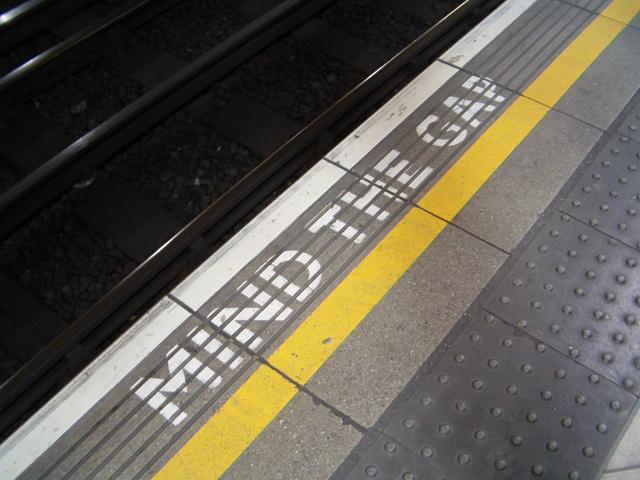
Mind the Gap

An issue that deserves some attention is the gap between what our school district educators and staff in leadership and support positions know about how so-called 21st Century/Personalized Learning ("21C/PL") can/could/should work and what they are doing to allow it to flourish and receive critical examination in our schools. Digital skills and literacy aimed at making relevant technology a regular component of education (more than just an elective) is built on a foundation going back about 12 years (to 1999), but hitting a critical juncture about 6 or 7 years ago. The emergence of the "21C/PL" jargon and the challenge to rethink aspects of program delivery are real tests of that foundation, and make it necessary to reflect on how decisions made in the last few years will affect the passage of "21C/PL" theory into practice. Rather than build on success and respect the existing diffusion models that work among educators, our district appears to be developing its model for change in isolation and/or contradiction of relevant evidence, existing resources (human and otherwise), input from practitioners, and research initiatives designed specifically to address, examine, and assess "21C/PL."

We've seen some interesting examples in the past year of how ubiquitous technology (tablets, mobile devices, etc.) could have a major impact on the classroom and for learning in general, both positive and negative. This is accompanied by a sea of literature and online content related to"21C/PL," often cliched or poorly understood but part of our reality nonetheless. We are surrounded on TV, the web, and print media with powerful new educational uses and apps for pods and pads, and hints at what makes tech-based learning work. Locally, UNBC prof Andrew Kitchenham has recently put out 2 texts/etexts on mobile learning strategies and blended learning environments (distance + face-to-face). Our board office staff have acknowledged a need to take these ideas seriously, and have even written them into various plans, and is beginning to use the "talk" (for better or worse) of "21C/PL." The problem remains that the milieu has shifted in our district from wide-spread interest and action in the use of innovative technology to frustration over the lack of communication and support. This has been compounded by the rejection of both relevant feedback and a number of "21C/PL" proposals which would have provided teacher and student experiences to put "21C/PL" theory through its paces. I've written and spoken on these ideas enough that I'll spare the details here.

For a reference, I take "21C/PL" to be any initiative that aims at one or more of these goals:
1. Greater involvement of parents & community by allowing/encouraging/facilitating learning opportunities outside of schools
2. Wider and more effective use of distance and blended learning environments
3. New flexibility for project, course, and program options/designs by students and teachers, including a new view or curriculum as a shopping list rather than a set of prescriptions
4. Removing barriers to the uptake of new technologies and teaching/learning that incorporates mobile devices, online or cloud-based learning objects, and interactive digital systems (e.g. social networks)
5. Changing role of teaching from directing student learning and leading the inquiry to that of facilitator or "guide on the side"

A number of elementary and secondary teachers, with varying levels of access and expertise with technology, continue to make forays into these "21C/PL" goals in their lessons, student activities, project construction, unit structures, and assessment. In an effort to increase the ambition and impact of their work, at least five "21C/PL" project proposals (learning team/funding grant applications) were floated last year, all of which were ironically rejected by principals or district staff (no one is quite sure who or why, although budget shortfall was never mentioned). At the same time, a presentation aimed at gathering input on district tech directions resulted in a gloss of the issues and a brush-off to the responses. These rejections, added to the platform change and the end of many district support systems and structures (notably the DTT), has created a shockwave of distrust between teachers and admin/district staff and has made the job of "moving forward" that much more difficult. In some respects it was unavoidable as the cutbacks of 2010 surely meant there would be less capacity (staff/money/vision) for technology leadership, coordination, and collaboration. Teachers and students are used to obstacles, and so the business of learning and experimenting with new technology continues, with or without the necessary supports. This is the current milieu in which we ask questions about what we do, and in which we look for more open and sensible answers from district leadership than we have had over the last two years, well documented in the district's tech feedback wiki (now expired), and various 57 Online forums.

The "historic" milieu is also important. Teachers and students (usually with district support) have been continuously trying, mastering, discarding, renewing digital technologies and associated methods for much of the last 12 years -- websites, movie making, blogs, wikis, podcasts, mashups, digital recordings and compositions for assessment, assembling evidence, and presentation. There has been a dynamic mix of content-creation and content-consumption, each fueled by different needs and skills, but both important for teaching and learning.

The year 2004 deserves a closer look. This was a time of tech coaches, a planned system of training and workshops starting with a scope & sequence but aimed at creative, student-centered transformations, coordinated/vertically integrated leadership (from asst super though admin, tech support, tech support teacher leaders, diverse teacher leaders, teacher practitioners, and students -- all more or less committed to the same goals). In that year (give or take a few months) TLITE's first cohort was underway (SFU diploma in tech-based teaching & learning), Tech for Learning Leadership Team was established, "Key Tech Contacts" picked at every school, the District Tech Team created its first Tech Standards document, and it was the last time we saw a collaboratively constructed District Technology Plan for Student Success. 2004 marked the beginning of a process of standardization which ultimately led to the computer greening program and platform consolidation.

2004 was also when the work of "QLG" wrapped up. The Quality Learning Globally group assembled teachers and admin/district staff, most of which were tech leaders, to inquire into some key problems emerging with tech-based learning. Among other things, they met about 8 times, studied, and experimented with distance/blended/synchronous/asynchronous environments -- an early and intense look at what we now call "21C/PL." The QLG research concluded with a number of observations aimed directly at three connected questions faced by (and encouraged by) the district:
  1. What should distributed learning look like... should it occur at many schools and be integrated into the options faced by students (course selection) and teachers (course design, career specialization), or should distributed learning be the purview of our distance ed school?
  2. What technology should we use, and why... virtual classrooms, CMS, platforms, peripherals, access issues, budget & greening issues, what works in various contexts?
  3. What pedagogy emerges from, or shapes, the technology and the choice of delivery models... synchronous vs asynchronous, what degree of "blending," how is the vision, coordination, and support sustained in schools and in the district? 
The research looked at teacher and student experiences in contexts that explored as many of the possibilities brought up by these questions as possible. The QLG group asked these questions from the perspective of teachers and students, and in the end recommended:
  1. Distributed Learning should happen at every school, at any time in which teachers in these schools were willing to experiment in such a way that could be supported by administration. Teachers excited to try teaching an online course or increase the amount of interactive technology they use with regular classes are the best bet for success. Dumping online course work and new tech on unwilling teachers will not work and will halt any momentum built elsewhere. While the integration of distributed learning has a logical place at the secondary level, it should be placed within the continuum of integrating all forms of teaching and learning strategies that make use of rich media and interactive technology, not just the ones that lead to more independent (distant) student learning. This has implications for the continued promotion of technology skills and digital literacy among staff and students, and commitments to support, training, and leadership.
  2. Online and distance learning works best when the students are also connected to a learning community and teachers -- real people (with bodies and nuanced expression) and real social environments that are essential for human development, so some face-to-face is a must except for special cases and for most should be the the primary experience, even at higher grades. The group spent a lot of time on the creative/collaborative/critical process involved in building and analyzing content (distributed "learning objects," resources , courses). Some felt there should be an attempt to build original, professional resources specific to BC curriculum contexts, while others were confident that existing online (free/external) resources would increasingly meet learning needs. This has implications for inter-school communication/collaboration and the coordination of some aspects of course programming across the district.
  3. Technology and distributed learning should not remove and try to replicate the best of the classroom experience, but should seek to revolutionize the worst and most problematic aspects of the classroom experience. Thus virtual classrooms that imitate real discussions are often a step backward unless no alternatives exist. Just as the powerpoint can take a meaningful presentation and turn it into something segmented, trite, or didactic, interactive technology can create addictive, self-absorbed recluses where once were curious, social kids. The group was confident that the interactive web could extend and enrich but not replace the social fabric of schools. This has implications for school and district tech direction, planning and licensing. 
These conclusions were, for the most part, rejected or ignored. They were supported by then principal of PGSS (later an asst superintendent), but the "discussion" at the board office supported a focus on the distance ed school (rebranded the CLA) rather than widespread uptake of distributed learning and tech-based blended learning environments at many schools. PGSS was given a few "backdoors" to continue practicing some distributed learning (license shifting to allow videoconferenced classwork with McBride, more use of Coolschool, etc.). CLA took a couple of years to ponder on this and then very slowly began the process of moving courses into Moodle and offering more online learning opportunities. Some tech innovation grants created pockets of creative teaching & learning embracing these (or similar) conclusions. This helped offset the need for regular, meaningful conversations and collaboration with teachers.

These exceptions aside, the district has closed the door on most "21C/PL" projects and the buzz around educational technology has faded. Questions and invitations to dialogue from tech-leading teachers to the SBO staff remain unanswered. The coherent tech plan (which, at a minimum, was supposed to explain what's going on, why, how, when), promised in April 2010, has still not materialized. The extensive feedback on the March 2011 announcements about tech directions have been utterly ignored -- even the SBO's own plans to follow-up on the announcements appear to be on hold indefinitely. The means for collaboration on technology problems (wikis, social networking, etc.), and the external encouragements (e.g. consider Dr. Kitchenham's new texts), have never been more readily available, and yet we have entered a period of stagnation and confusion and "go it on your own" that has taken us back about 12 years, although it is still possible to see the curiosity if not the energy that accompanied the heady days of shocking new technology.

This analysis may sound a bit cold, but personally, I can't wait to be proven wrong -- those who know me realize I'll be the first to celebrate an end to dysfunction. I also realize that our SBO may no longer have the staff (budget) to keep up with the level of engagement expected by teachers. More importantly, I don't mind the chaos... it makes it clear that I have to design my own learning systems, many of which bypass technology, if I want to create rich environments for my students, and find like-minded people to help. The school district has lost the capacity to "play" at this level with the current level of funding and choice of directions. I'm ready to be challenged on this, to be shown examples of how dynamic "21C/PL" experiments are working and have also been supported by schools and the SBO. I also realize, as others have pointed out, that the technology itself, the "stuff," is not the commodity in education or our school district, the commodity is the collection of teachers and students who are excited to learn and are willing to use relevant technology to do so.

Despite my many rants on technology and educational design, I am not generally excited with the majority of implicit promises and changes suggested by "21C/PL." The most interesting part to me is not the technology or the changing roles but the possibility that more community-based learning will allow more teens to get out into natural environments more often, do something to address the "Nature-Deficit Disorder" that has grown with the digital age.  I am also concerned about the effect technology has on the teenage brain.  My wife, for whom this is an even more important issue, suggested this CBC piece to help make my point: http://www.cbc.ca/video/#/News/TV_Shows/The_National/1233408557/ID=1954482931

The "it" of "21C/PL" is hard to define, and for many simply means an examined life as a teacher that is willing to innovate and experiment habitually. Bring "it" on, we're ready for it, many of us have been doing it for 10 years and already know which parts to take or leave, and the SBO must surely know by now that we're also ready to talk about it whenever you're ready... you know where to find us.